Wave characteristics

📝 Mini-cours GRATUIT

Wavefronts and rays

All waves can be described by the same sets of mathematical ideas. Detailed knowledge of one area leads to the possibility of prediction in another.

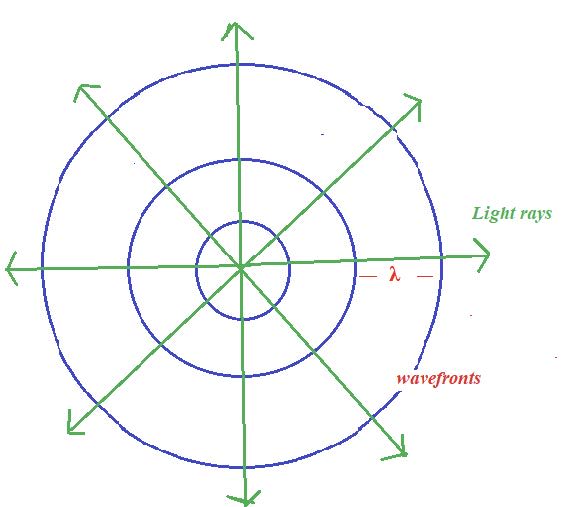
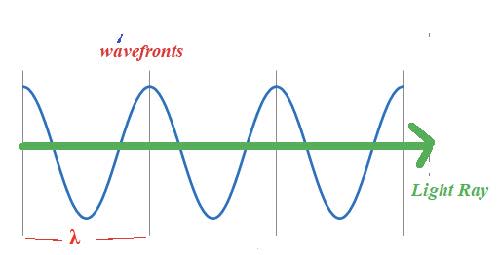
  • The direction of energy transfer of a wave can be shown as a ray.
  • The wavefronts are at right angles to the rays. All points on a wavefront have the same phase: they are generally shown at the crests and neighbouring wavefronts and are separated by a wavelength.
  • Rays and wavefronts are shown for linear and circular waves:
Amplitude and Intensity

  • The intensity, $\bf I$, is the power transferred by the wave per unit area: $\rm I = P/A$. The units of $\rm I$ are $\rm Wm^{-2}$.
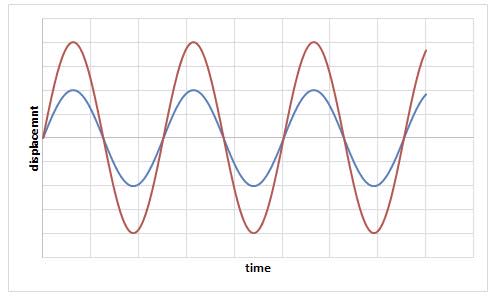
  • The intensity of a wave is proportional to the square of the amplitude, $\rm I \propto A^2$.
    The graph, for example, shows two sound waves of the same pitch/frequency. The red curve corresponds to a note of twice the amplitude of the blue note It has four times the intensity.

Inverse square law Of Radiation

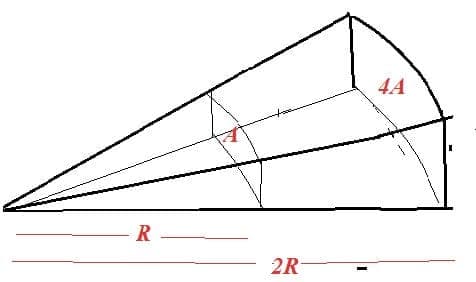
  • If the point source radiates a total power $\rm P$ in all directions, then the intensity I at a distance $\rm R$ away from the point source is:
    $\rm I = P/A$
    Where $\rm A$ is the surface area of a sphere: $\rm 4\pi R^2$
    $\rm I = P/A = P/4\pi R^2$
  • A doubling of distance will result in the reduction of the power received to a quarter of the original value.
    $\bf I \propto 1/R^2$

Superposition and interference

  • When two waves meet the resultant displacement is the sum of the individual displacements.
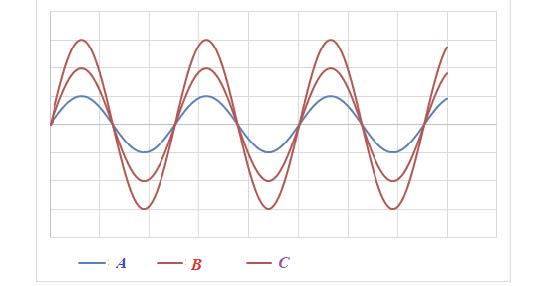
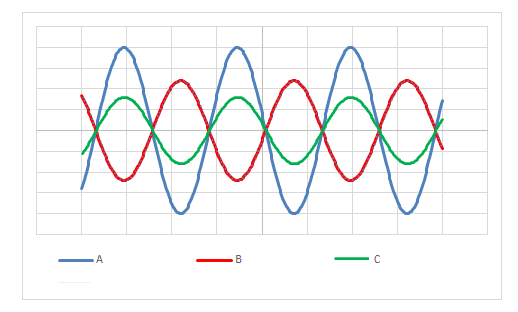
  • Constructive interference occurs when two waves of the same frequency meet crest to crest to form a wave with an increased amplitude.
    Wave $\rm A$ and Wave $\rm B$ interfere constructively to form wave $\rm C$:
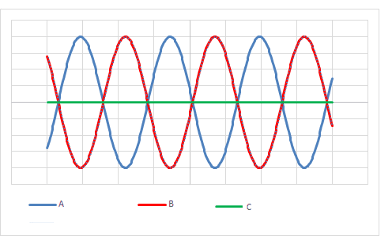
  • Destructive interference occurs when two waves meet crest to trough, the result is a wave of reduced amplitude.
    sans-titre-1
    When the two waves have equal amplitude and frequency. The resulting wave has zero amplitude: there is no wave.

Two-source interference

  • Sources are coherent if the phase difference between the sources is constant.
  • If identical waves from two coherent sources arrive at the same point in space they interfere constructively with each other.
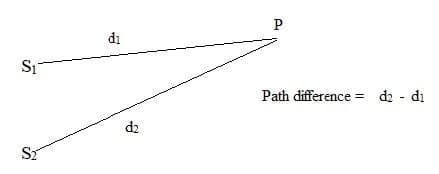
  • The nature of the interference depends on the difference in the distance the two waves have travelled: the path difference.
  • If the path difference between the two rays is a whole number (n) of wavelengths: there is constructive interference.
  • If the path difference between the two rays is an odd number of half wavelengths: there is destructive interference.
    $\rm (d_{2}-d_{1}) / \lambda=n$: constructive interference
    $\rm d_{2}-d_{1}) n +1 / 2$: destructive interference

Polarisation

  • Light is a transverse wave in which a pair of electric and magnetic fields oscillate, at right angles to each other and the direction of propagation.
  • The plane of vibration of electromagnetic waves is defined as the plane that contains the electric field and the direction of propagation.
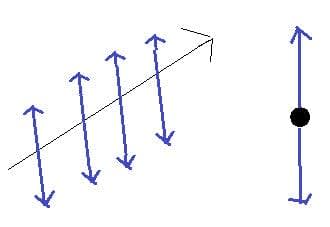
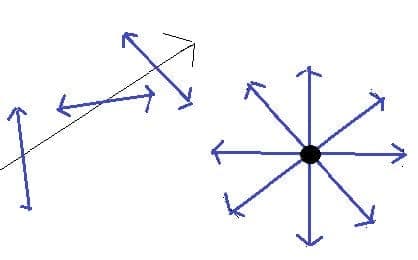
  • There are an infinite number of ways in which the fields can be oriented. Plane-polarized light has a fixed plane of vibration. Unpolarised light has many planes of vibration.
    Polarised light has a fixed plane of vibration.
    Unpolarised light has many planes of vibration.
  • Polarisation is a property of transverse waves only.
  • Most visible light sources like the sun and light bulbs produce unpolarized light.
  • Radio waves, radar, and microwaves are often plane-polarized.
  • Light can be polarised as a result of reflection or selective absorption. Reflected light is polarised parallel to the reflecting surface (see later).
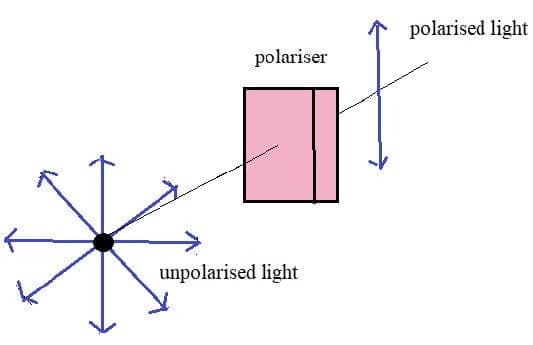
  • A polariser is a piece of plastic with a specific transmission axis. Only light with its electric field parallel to the axis is transmitted.
  • When unpolarised light is incident on a polariser with a vertical transmission axis. The transmitted light is vertically polarised.
  • The transmitted intensity is half of the incident intensity: $\rm I = I_0/2$.
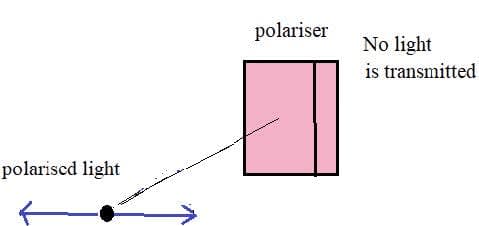
  • Polarised light with an electric field at right angles to the transmission axis is blocked.

Malus’ law

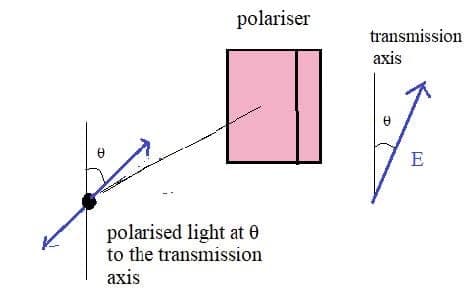
  • When the electric field is at an angle θ to the transmission axis the component that can be transmitted is $\rm E\cos\theta$.
    $\rm I/ I_0 = E^2 \cos^2\theta / E^2$
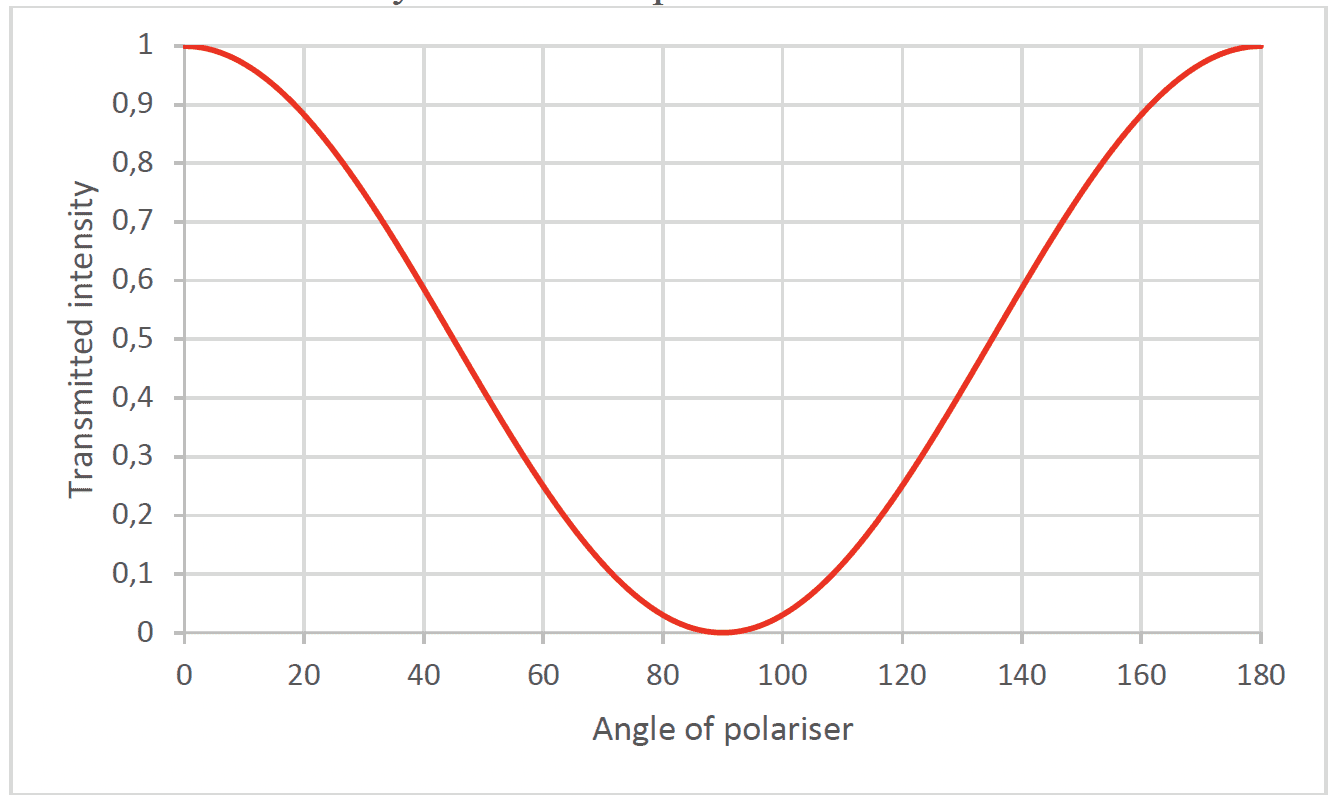
    The transmitted intensity is $\rm I = I_0 \cos^2\theta$ a result known as Malus’ law.
  • The transmitted intensity varies as the polariser is rotated from $0$ to $180°$ as shown:
  • Note the average value of $\cos^2\theta = ½$ which explains why the transmitted intensity of unpolarised light is half of the incident intensity, $\rm I = I_0/2$.

FAQ