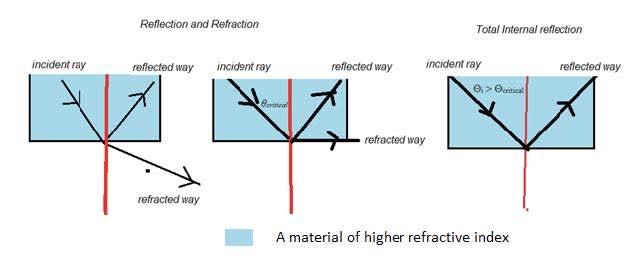
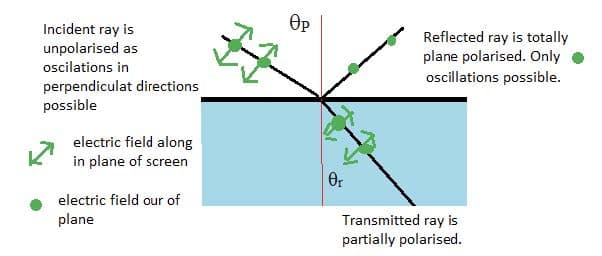
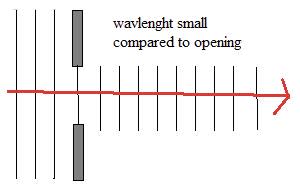
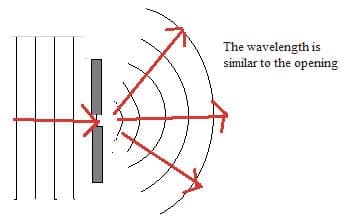
Waves interact with media and each other in a number of ways.
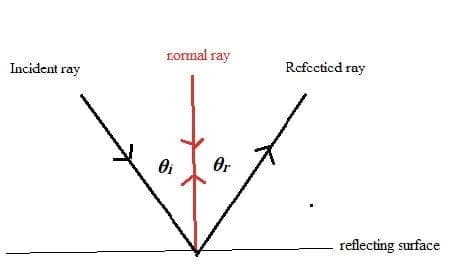
- The normal ray has an angle of incidence of $0^0$. It is the reference for other rays.
- A wave reflects off a smooth surface. The angle of incidence $\theta_i$ is equal to the angle of reflection $\theta_r$. The incident reflected rays and normal are in the same plane.
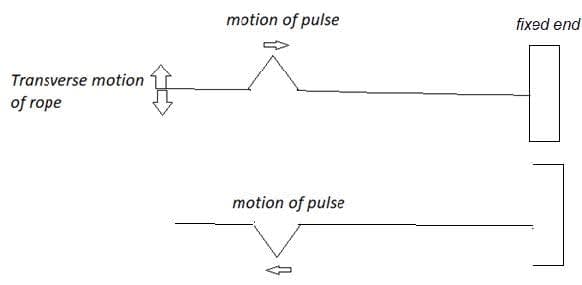
- A pulse travelling along a rope from is reflected at the fixed end. The reflected pulse is inverted.
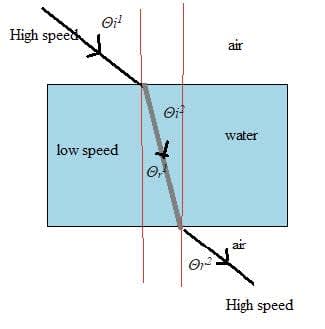
- A wave generally changes speed as it passes from one medium into another. If the speed decreases the ray is bent towards the normal. If the speed increases the ray is bent away from the normal.
- Let $v_{\text {air }}$ and $v_{\text {water }}$ be the speeds of the wave in the two media.
- In the example $\theta _i^{l}>\theta_r^{1}$ as $v_{\text {air }}>v_{\text {water }}$ and $\theta_{i}{ }^{2}<\theta_{\mathrm{r}}{ }^{2}$ as $v_{\text {water }} < v_{\text {air}}$.
- Consider the diagram below. In time $\Delta t$ the wavefront has moved $v_{\rm air}$ $\Delta t$ through the air and $v_{\rm water}$ $\Delta t$ through the water.
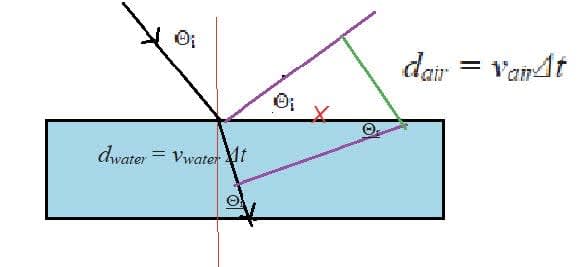
- This gives:
$\sin \theta_{i}=v_{\text {air }} \Delta t / \mathrm{X}$ $\quad$ $\sin \theta_r = v_{\rm water}\Delta t / \rm X$
$\sin \theta_{i} / \sin \theta_{r}=(v_{\rm air} \Delta t / X) /(v_{\rm water} \Delta t / \rm X)$
$\sin \theta_i / \sin \theta_r = v_{\rm air} / v_{\rm water}$ - The speed of light in a medium depends on the refractive index $\boldsymbol{n}$ of the medium:
$n_{\text {medium }}=c_{\text {vacuum }} / v_{\text {medium }}$ - This leads to $\sin \theta_{1} / \sin \theta_{2}=v_{1} / v_{2}=\mathrm{n}_{2} / \mathrm{n}_{1}$
$n_{1} \sin \theta_{1}=n_{2} \sin \theta_{2}$ - Water waves refract when they move from deep to shallow water as the speed is reduced in shallow water.
- The frequency of a wave does not change as it passes a boundary from one medium to another.
$A s v=f \lambda$
A change in speed corresponds to a change in wavelength.
The wavelength decreases if the speed decreases and the wavelength increases if the speed increases.