Travelling waves

📝 Mini-cours GRATUIT

Mechanical waves

There are many examples of waves behavior. All travelling waves carry energy.

  • A pulse an isolated disturbance in a medium that carries energy and momentum.
    For example: a pulse on a tight rope. The rope moves up and down and the pulse moves to the right.

    A wave is produced in the rope if the transverse motion of the rope is continuous.
  • A mechanical wave is the organised propagation of a disturbance through a medium. As the wave passes through the medium the molecules of the medium are displaced from their equilibrium positions.
  • Every point in the medium undergoes SHM with the same frequency and amplitude as the wave.
  • The wave can move very large distances but the molecules of the medium only undergo small displacements.
  • The speed of mechanical waves is determined by the properties of the medium.
  • Examples of mechanical waves include: sound, water, string and earthquake waves.
Electromagnetic waves

  • Electromagnetic waves do not require a medium and can propagate through a vacuum.
  • All electromagnetic waves travel at the same speed in a vacuum: $c = 3 \times 10^8~\rm m~ s^{−1}$.
  • The waves are propagated by oscillating electric and magnetic fields.
  • Examples of electromagnetic waves include in order of increasing energy: radio, microwave, infrared, visible light, ultraviolet x-rays, and gamma rays.

Important quantities in waves and simple harmonic motion

  • A crest is a point of maximum displacement.
  • A trough is a point of maximum negative displacement.
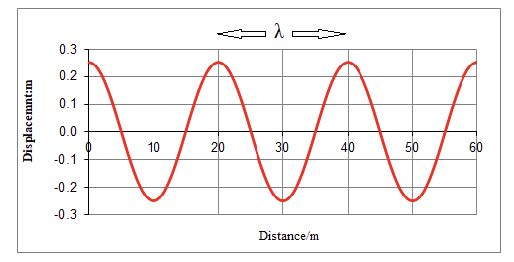
  • The wavelength, $\lambda$ is the length of a full wave. It can be determined from a displacement–distance graph. It is the shortest distance (in metres) along the wave between two points that are in phase with one another. For example: two crests or two throughs.
  • The wave speed, $\boldsymbol{v}$, is the distance a crest moves in the medium in unit time. It is the of speed of energy transfer.
  • If the wavelength is $\lambda$ and there are $f$ waves produced every seconds.
    Distance travelled every second $= v = f \lambda$.

Transverse waves

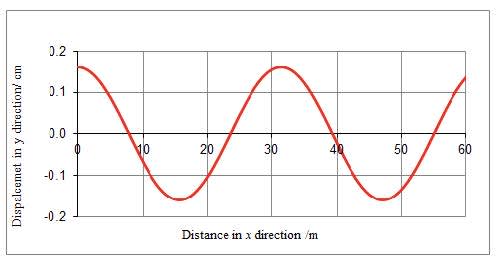
  • For a transverse wave, the displacement of the medium is at right angles to the direction of energy transfer. For example, if the wave is propagating in the x direction the oscillations are in the y direction.
  • The displacement–distance graph for a transverse is like a “snap-shot” of what the medium looks like at a particular instant of time.
  • Electromagnetic waves are transverse wave with the oscillations of a magnetic and electric field both at right angles to the direction of propagation.
  • A wave in a string is also a transverse wave.

Longitudinal waves

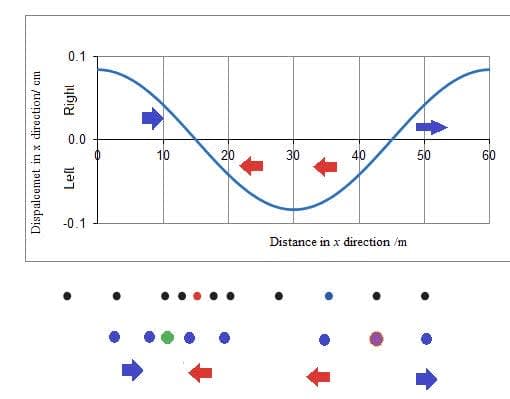
  • In longitudinal waves the displacement of the medium is parallel to the direction of energy transfer.
  • Sound is a longitudinal wave.
    The arrows represent the displacement of the particles in medium at a particular time.
    Blue to left. Red to the right.

    The particles on the left and right are moving towards to the green particle.
    It is a centre of compression

    The particles on the left and right are moving away from the purple particle.
    It is a centre of rarefaction.

  • It contrasts to transverse waves the displacement–distance graph for a longitudinal wave is not a “snapshot” of what the particles in a medium looks like at a particular instant.

🎲 Quiz GRATUIT


FAQ