Thermal concepts

📝 Mini-cours GRATUIT

Kinetic theory

  • Kinetic theory describes the differences in the properties of solids, liquids, and gases on the basis of the different movement and arrangement of the particles.
  • The absolute temperature in kelvin is a measure of average kinetic energy.
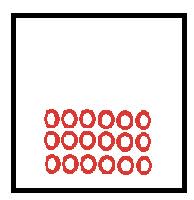
    Particles in a solid vibrate about fixed position as held together by attractive forces.
    Particles in a liquid move in fixed volume as particles held closely together by attractive forces.
    Particles in a gas can move freely as negligible attractive forces
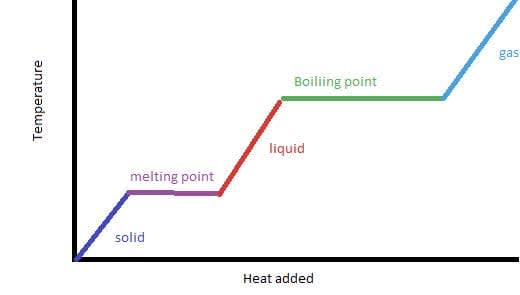
  • Every substance changes state by melting/freezing and boiling/condensing at a defined temperature at constant pressure. During a phase change the temperature does not change although the substance continues to be heated. The heat is used to change the separation between the particles rather than their kinetic energy.
  • More heat is needed to convert a liquid into a gas than a solid into a liquid as more separation occurs in boiling than melting.

Temperature and heat

  • Temperature is a measure of how hot or cold a body is.
  • The average random kinetic energy of the molecules of a substance is proportional to the absolute temperature of the substance.
    The average $\rm KE$ of a molecule of monatomic gas $\rm = 3/2 k_BT$ ($\rm T$ measured in kelvin).
    $\rm k_B$ is Boltzmann’s constant $\rm = 1.38 \times 10^{-23}~J~K^{-1}$.
  • The Kelvin (absolute) and Celsius scales are related by $\rm T(K) = t(°C) + 273$.
    Note that $\rm\Delta T$ is the same if measured in $\rm K$ or $\rm °C$.
  • Molecules have no kinetic energy at absolute zero $\rm 0~K$.
    Heat, $\bf Q$, is energy that is transferred from one body to another due to a difference in temperature. Heat flows from a body with high temperature to a body with low temperature until they reach thermal equilibrium.

Evaporation and boiling

  • A liquid boil at a specific temperature but a liquid can evaporate at any temperature.
  • When a liquid boils molecules escape from anywhere in the liquid but only molecules at the surface escape during evaporation.
  • Evaporation leads to a reduction in temperature as the escape of the faster molecules reduces the average kinetic energy and thus the temperature.


Internal energy

  • The Internal energy $\bf (U)$ is the sum of the total random kinetic energy of the molecules and their intermolecular potential energy.
  • For an ideal gas (see $3.2$) the intermolecular forces are zero and so internal energy only consists of random kinetic energy.

Intermolecular forces

  • There are (electrostatic) forces between molecules. They decrease with increasing separation.
  • The forces are strongest in the solid phase and weakest in the gaseous phase.
  • Work has to be done to separate molecules, which increases the intermolecular potential energy, and the internal energy of the substance.
  • Gases have more potential energy than liquids. Liquids have more potential energy than solids.

Heat capacity

  • The heat capacity $\bf (C)$ of a body is the energy required to change the temperature by one degree. Its units are $\mathrm{J} \mathrm{K}^{-1}$.
    $\rm Q=C \Delta T$
  • The specific heat capacity (c) of a material is the energy needed to increase the temperature of a unit mass of the material by one degree.
    $\mathrm Q=m c \Delta \rm T$
  • The heat capacity of a body made from one material of mass $m$ is related to specific heat capacity:
    $\mathrm C=m c$.
  • For water, $c=4~200 \mathrm{~J} \mathrm{~kg}^{-1} \mathrm{~K}^{-1}$ . $~4200 \mathrm{~J}$ is needed to change the temperature of $1.0 \mathrm{~kg}$ of water by $1° \mathrm{C}$.

Specific latent heat

  • Specific latent heat $\bf (L)$ is the energy needed required to change the phase of a unit mass of a substance at constant temperature.
    $\mathrm Q = m\rm L$
    At the melting point: $\rm L$ is the specific latent heat of fusion $\rm L_{fusion}$.
    At the boiling point: L.is the specific latent heat of vaporisation $\rm L_{vaporisation}$.
    The units are $\rm J~ kg^{-1}$.
  • The specific latent heat of vaporisation of a substance is greater than the specific latent heat of vaporisation as the change in particle separation is greater when a liquid is boiled than when a solid is melted.

FAQ