The structure of matter

📝 Mini-cours GRATUIT

The nuclear atom

All matter is made from fundamental particles called quarks and leptons. Matter has a hierarchical structure:  quarks make nucleons, nucleons make nuclei, nuclei and electrons make atoms and atoms make up molecules.

  • The atom consists of the three subatomic particles:
    Subatomic particle Position Charge / $\bf e*$ Mass / amu
    Protons Nucleus $\rm +e$ $\sim 1$
    Neutrons Nucleus $0$ $\sim 1$
    Electrons Outside the nucleus. Gives the atoms its volume. $\rm -e$ $1/1836 \approx 0$

    *
    e is the charge of the electron
  • Evidence for the existence of the small, massive, positively charged nucleus in the centre of the atom came from the Rutherford, Marsden, Geiger experiment.
  • Alpha particles (massive positively charged particles) from a radium source were directed at a thin gold foil. Most of the alpha particles passed through undeflected but a small number were scattered by small angles, and a very small number even bounced back.
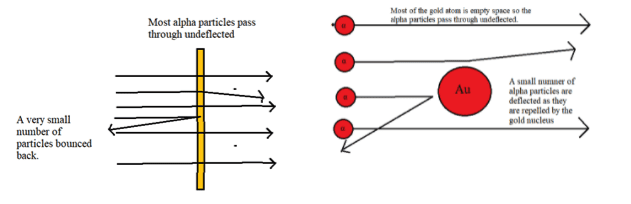
  • The results show that the atom is mostly empty space but has a dense positively charged nucleus at its center. There is electrostatic repulsion between the positive charge on the alpha particles and the positive charge in the nucleus.
The standard model

  • Elementary particles are particles that are not made out of smaller constituents. The electron is an elementary particle but protons and neutrons are not as they have an internal structure. 
  • Quarks were introduced to account for the internal structure of the proton and neutron and explain patterns in the properties of many other particles.
  • In the standard model elementary particles belong to one of three different classes: quarks, leptons or exchange particles or bosons. Electrons are leptons. Protons and neutrons are made from three quarks. 
  • There are six types of quark and six types of lepton.
  • Some key properties or quantum numbers are used to characterise particles. They include charge, baryon number, spin, strangeness, lepton number and colour.
    Charge Quarks Baryon number
    1st gnt° 2nd gnt° 3rd gnt°
    $\rm +\dfrac{2}{3} e$ Up $\rm (u)$ Charm $\rm(c)$ Top $\rm (t)$ $\dfrac{1}{3}$
    $\rm -\dfrac{1}{3} e$ Down $\rm (d)$ Strangeness $\rm(s)$ Bottom $\rm(b)$ $\dfrac{1}{3}$
  • The following points should be noted:
    • All quarks have a baryon number of $+\dfrac{1}{3}$. Three quarks make one baryon (see later).
    • All quarks have a strangeness number of $0$ except the s quark which has a strangeness number of $-1$. Anti strange quarks have a strangeness of $\mathrm{S}=+1$.
    • All quarks have a charm of 0 except the $c$ quark that has a charm number of $1$.
  • The six different types of lepton and quark are referred to as different flavours. The three pairs of particles are often referred to as generation on the basis of their mass. The first generation has the smallest mass and the third the largest.
    Charge Leptons
    1st generation 2nd generation 3rd generation
    $\rm -e$ $\rm E$ $\mu$ $\tau$
    $0$ $\rm V_{e}$ $\rm V_{\mu}$ $\rm V_{\tau}$
  • Every particle has a corresponding antiparticle with the same mass but with opposite quantum numbers such as electric charge. For example, the electron and the electron neutrino have a lepton number of $+1$. The antielectron (positron) and the antielectron neutrino have a lepton (electron family) number of $-1$.
  • Some particles are their own antiparticle. For example the photon and the graviton. These particles are necessarily electrically neutral.

Exchange particles

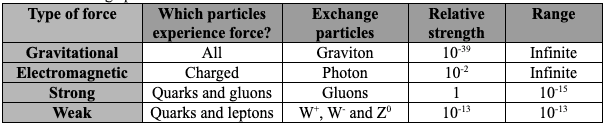
  • Exchange particles are associated with the four fundamental forces of nature.
  • The weak force mediates beta decay and so acts on quark and leptons
  • The larger the mass of the exchange particles, the smaller the range of the force. For example, the electromagnetic force has infinite range as it is mediated by photons which have zero mass. These particles are also called gauge or “exchange” bosons.

Hadrons

  • Particles made of quarks are called a hadrons. There are two types of hadron: baryons and mesons.
  • Baryons are made of three quarks. Protons and neutrons are examples of baryons. Note they have a baryon number of $1$.
    Baryon Compo. Charge Baryon number
    Proton $\rm uud$ $\rm 2(+\frac{2}{3}e)$ $+$ $\rm 1(-\frac{1}{3}e)= +1$ $2(\frac{1}{3})$ $= 1$
    Neutron $\rm ddu$ $\rm 2(-\frac{1}{3}e)$ $+$ $\rm 1(+\frac{2}{3}e)= 0$ $3(\frac{1}{3})$ $=1$

    Mesons are made of one quark and one antiquark. They have a baryon number of $0$. The $\pi^{+}$and $\pi^{-}$ are examples of a meson.
  • The net charge of a hadron is always a zero or a whole number, although the quarks themselves have fractional electric charge.
  • Although many particles do exist virtually everything in the Universe is made up of the first generation of each type of particle.
  • Atoms are made from nucleons and electrons. The electron is a first generation lepton and the proton and neutron are made from different combinations of the first generation of quarks: the up and the down.

Conservation laws

  • We know from earlier topics that energy and momentum are conserved when particles collide. Other properties are conserved when particles interact in particle physics.  The quantum numbers electric charge, baryon number and lepton number are always conserved.
  • Strangeness is an important exception. It is conserved in the electromagnetic and strong interactions but not in the weak interaction.

Confinement and colour

  • Quarks cannot be observed as isolated free particles. 
  • The force between the quarks does not decrease with separation so an infinite amount of energy is needed to fully separate them.  As the quarks are separated the supplied energy will eventually be sufficient to instead create a quark–antiquark pair out of the vacuum. For example when energy is supplied to separate the quark and antiquark in a meson a meson–anti-meson pair and not free quarks are produced.
  • Quarks also have a fundamental property called colour. Quarks in a baryon are red, green and blue together adding up to white.  Quarks in a meson are red and anti-red or green and anti-green and blue and anti-blue. Again adding up to no colour: hadrons always appear as combinations with no colour.
  • As isolated quarks cannot be observed, colour cannot be observed directly.

Feynman diagrams

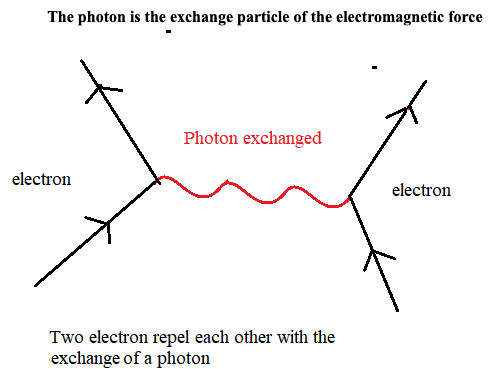
  • Feynman diagrams are a pictorial way of viewing particle interactions.
  • In the diagrams below the x-axis represents time going from left to right and the y-axis represents space. (Sometimes these two axes are reversed. To view them in the alternative way, turn the diagram anti-clockwise by 90°).
  • Some simple rules:
    • Lepton–lepton and quark–quark interactions are represented as a junction or vertex with one arrow going in and one going out.
    • Quarks or leptons are solid straight lines.
    • Exchange particles are generally wavy lines but gluons are curly.
    • Arrows from left to right represent particles travelling forward in time. Arrows from right to left represent antiparticles travelling forward in time.
    • The junctions are linked by a line which represents the exchange particle involved.

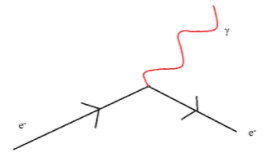
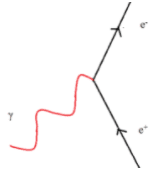
An electron emits a photon.
The gamma photon first appears at the vertex.

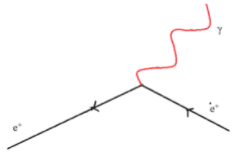
A positron emits a photon.
The photon goes forward in time. The antiparticle goes back in time.  

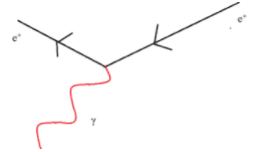
A positron absorbs a photon.
The photon goes forward in time. The antiparticle goes back in time.   

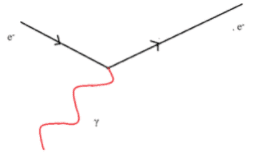
An electron absorbs a photon. 
The photon is moving forward in time until the vertex.

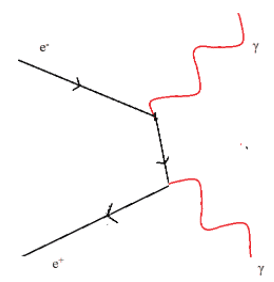
An electron and positron annihilate each other and produce two photons.
A photon decays to produce an electron positron pair.

Beta decay A second look

We saw earlier that in beta minus decay a neutron decays to a proton within the nucleus and the electron and antineutrino $(\nabla)$ are emitted:
$\rm 10 n \rightarrow 11 p+0-1 e+00 \nabla$
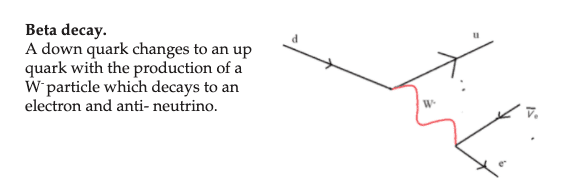
As a neutron is $\rm udd$ and a proton is $\rm uud$ we can see that this involves a down quark changing to an up quark with the production of an electron and an anti-neutrino:
$$d \rightarrow u+^0_{-1} \rm e+^0_0 \nabla
$$
As a down quark has a charge of $-\dfrac{1}{3}$ and an up quark a charge of $+\dfrac{2}{3}$ we can see that charge, baryon number and lepton number are conserved.
The conversion of a down quark to an up quark is a two step process involving the $\rm W^{-}$exchange particle which highlights the role of the electro weak force in the process.
$$d \rightarrow u+\rm W$$
$$\rm W^{-} \rightarrow ^0_{-1} e + ^0_0 \nabla$$
Both steps are in agreement with the conservation laws and can be represented by a Feynman diagram.


FAQ