
One of the fundamental questions in calculus is how fast something is changing at a particular moment in time. For example, consider a car leaving home and driving down a straight road. We might be interested in how fast the distance is changing. Before calculus, algebraically we could determine how far away the car was from home at a certain moment in time. Now, using calculus techniques, we can determine how fast this distance is changing at a specific moment in time. Consider the case below where the distance $d(t)$ in meters, a car is from home after $t$ seconds is given by: $d(t)=t^2+3t+1$
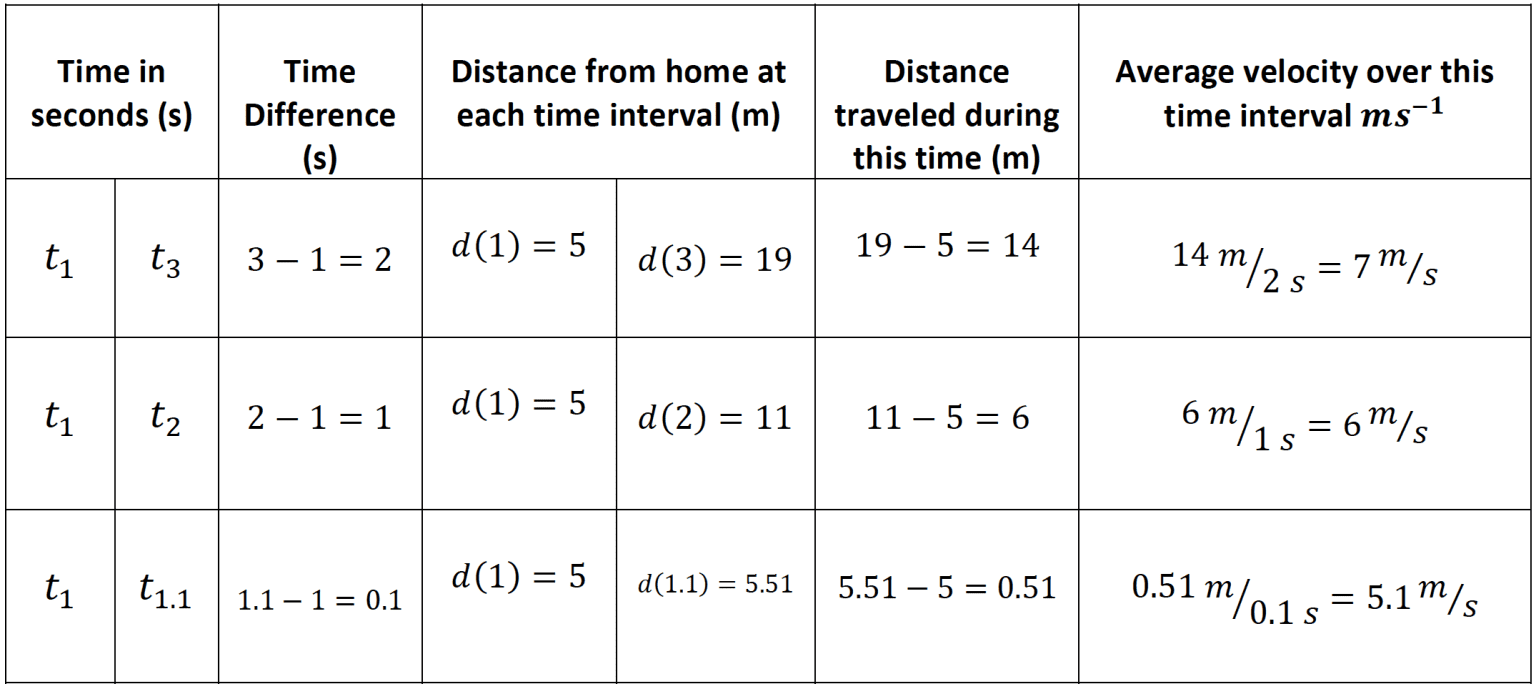
Evaluating this function from $t_1$ to $t_1$ would produce a calculation that involves dividing by $0$. So how do we fix this? We fix this by considering the limit of the function. That is to say, the limit of this function as time approaches $1$ is $5$. In terms of how fast the distance is changing, the moment in time at $t=1$, is called the instantaneous rate of change of the distance, or velocity. In calculus terminology we refer to this as the derivative function. Graphically, the derivative evaluated at a point is the slope of the tangent line to the function at that point.
Given a polynomial which is a power function of the form:
$f(x)=ax^n$ where $a$, $n \in \mathbb R$
the derivative is denoted $f'(x)$ and can be written as:
$f'(x)=nax^{n-1}$
This is referred to as The Power Rule in calculus and is used in determining the instantaneous rate of change of any power function at a specific moment in time.
Example 1: Determine $f'(x)$ of the function $f(x)=4x^3−5x^2+12x−1$
Using the Power Rule from above, we can differentiate term by term to get:
$f'(x)=(3)(4)x^{3−1}−(5)(2)x^{2−1}+12(1)x^{1−1}$ $=12x^2−10x+12$
This function, the derivative function $f'(x)$, will tell us how fast or slow the original function $f(x)$ is changing at any specific moment in time $x$.
Note: The derivative of the constant $−1$ in the function is $0$. This is not surprising since constants do not change.
Example 2: Determine the slope of the tangent line to the function $f(x)=2x^3+4x+8$ at the point where $x=1$.
Using the Power Rule from above, we can differentiate term by term:
$f'(x)=(3)(2)x^3−1+(4)(1)x^1−1$ $=6x^2+4x$
$f'(1)=6(1)^2+4(1)=6+4=10$
Note: This value is telling us that at the moment in time when $x=1$, the function is changing at a rate of $10$ units per unit of time.
