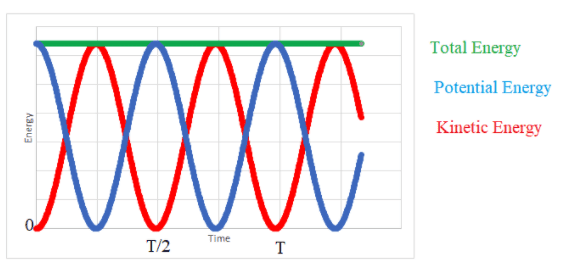
Simple harmonic motion involves an exchange between kinetic and potential energy in a system.
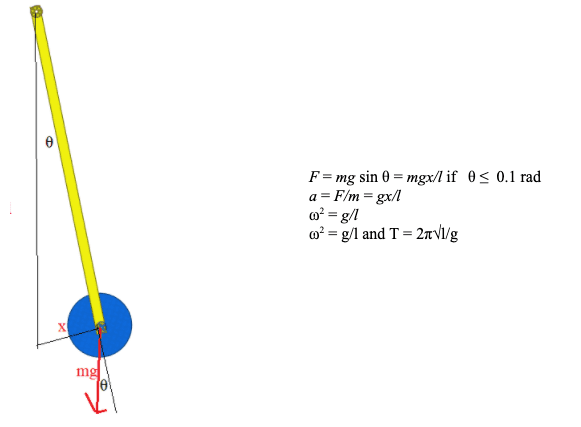
- In SHM the acceleration (or the net force) is proportional to the displacement from equilibrium but in the opposite direction.
$a=-\omega^{2} x$ where $\omega$ is a constant called the angular frequency. - This can be expressed as $\mathrm{d}^{2} x / \mathrm{d} t^{2}=-\omega^{2} x$
And has the solutions:
The format of the relationships, (a) or (b), depends on the displacement at time $(t)= 0$.(a) $x=x_{0} \sin \omega t$
$\mathrm{d} x$ $\mathrm dt=v$ $=+ x_{0} \omega \cos \omega t$
$\mathrm{d}^{2} x / \mathrm{d} t^{2}$ $=a$ $=-x_{o} \omega^{2} \sin \omega t$ $=-\omega^{2} x$(b) $x=x_{0} \cos \omega t$
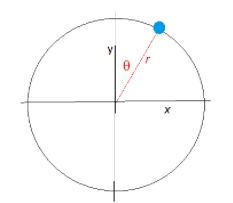
$\mathrm{d} x / \mathrm{d}t=v$ $=-x_{0} \omega \sin \omega t$ $\mathrm{d}^{2} x / \mathrm{d} t^{2}$ $=a$ $=-x_{0} \omega^{2} \sin \omega t$ $=-\omega^{2} x$ - The period for a complete cycle is $\mathrm{T}$. This corresponds to an angle $2 \pi$.
$\omega=2 \pi / \mathrm{T}$ - Other relationships follow from these equations:
$x^{2}=x_{0}{^{2}} \sin ^{2} \omega t$
$v^{2}=\omega^{2} x_{0}{^{2}} \cos ^{2} \omega t \quad v^{2} / \omega^{2}=x_{0}{^{2}} \cos ^{2} \omega t$
$x^{2}+v^{2} / \omega^{2}=x_{0}{^{2}} \sin ^{2} \omega t+x_{0}{^{2}} \cos^{2} \omega t$
$x^{2}+v^{2} / \omega^{2}=x_{0}{^{2}}\left(\sin^{2} \omega t+x_{0}{^{2}} \cos^{2} \omega t\right)$
$x^{2}+v^{2} / \omega^{2}=x_{0}{^{2}}$
$v^{2} / \omega^{2}=x_{0}{^{2}}-x{^{2}}$
$v^{2}=\omega^{2}\left(x_{0}{^{2}}-x^{2}\right)$
$v=\sqrt{\omega^{2}}\left(x_{0}{^{2}}-x^{2}\right)$