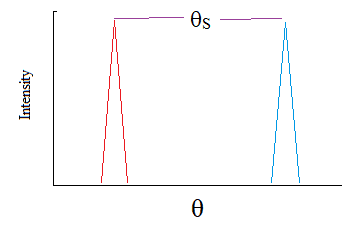
Resolution places an absolute limit on the extent to which an optical or other system can separate images of objects.
- Resolution is the ability to distinguish two separate objects as separate objects.
- Light from two point sources diffracts, when it passes through an aperture. If the two sources are separated by a small angle the diffraction patterns will merge and the two sources will appear as one.
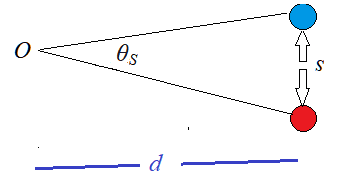
- The two objects in the diagram are at a distance $d$ from the observer $\rm (O)$ and separated by a distance $\rm s$. The angular separation is $\rm \theta_S \approx s / d$
- To examine whether two sources are resolved the angular separation $\theta_{\mathrm{S}}$ must be compared with the resolution angle, $\rm \theta_{R}$, between the central maximum and the first minimum in a diffraction pattern.
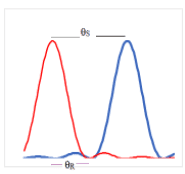
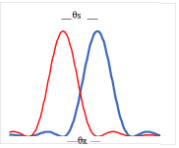
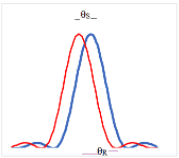
$\rm
\theta_{S} > \theta_{R}$
The sources are clearly resolved.$\rm \theta_{S} = \theta_{R}$
The sources are just resolved. The central maximum of one coincides with the first minimum of the other.$\rm \theta_{S} < \theta_{R}$
The sources are not resolved - The angle $\rm \theta_{R}$ between the maximum and minimum for a circular aperture $=1.22 \lambda / b$ Where $b$ is the diameter of the circular aperture used to collect light from the sources.
- According to the Rayleigh criterion: two sources are just resolved if the central maximum of the diffraction pattern of one source falls on the first minimum of the other: $\rm \theta_{S}=\theta_{R}=1.22 \lambda/ \mathrm{b}$