Interference patterns from multiple slits and thin films produce accurately repeatable patterns.
- For two-source interference to occur the two sources:
- must be coherent: the phase difference between the sources is constant
- have approximately the same amplitude
- have the same polarisation.
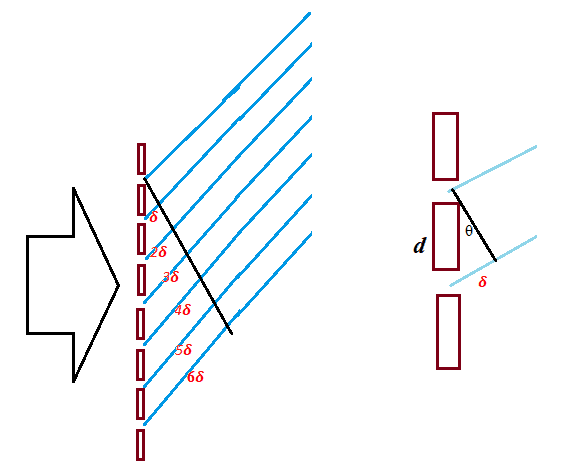
- Bright fringes occur at angles $\theta$ where the path difference corresponds to a whole number of wavelengths. The waves interfere constructively.
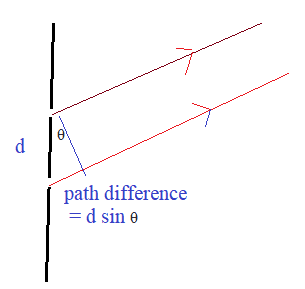
$d \sin \theta=n \lambda$
For small angles of $\theta$ in radians $\sin \theta \approx \theta$ when $n=1$
$d \theta=\lambda$
Let the distance between the central and first bright fringe $=x$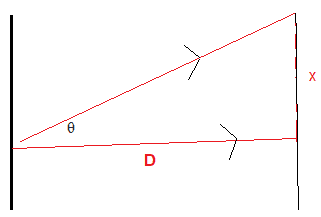
$x=\rm D \theta$
$x=\mathrm D \lambda / d$
$\lambda=d x / \mathrm{D}$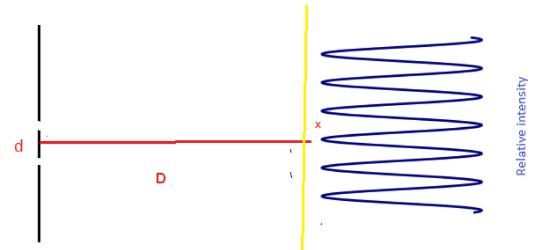
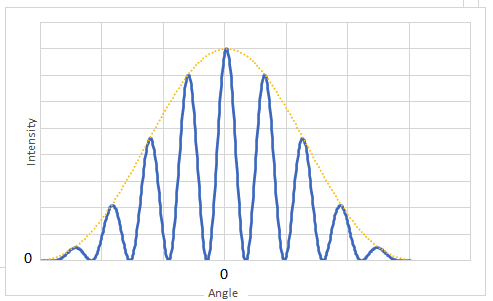
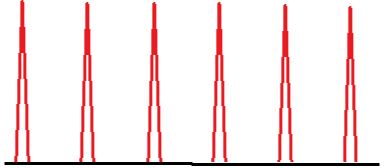
- The diagrams show the intensity observed far from the two slits The pattern shows equally spaced maxima whose intensity is the same.
- The distance between the fringes $x$ increases when the distance $d$ between the slits decreases or when the wavelength increases.