Fields at work

📝 Mini-cours GRATUIT

Gravitational potential energy

Similar approaches can be taken when analyzing electrical and gravitational potential problems.

Gravitational potential energy

  • The work done in moving a point mass m from infinity to a point near a mass $\rm M$ is:
    $\rm W = −GMm/\cal r$
  • The gravitational potential energy between the two masses decreases as they are moved together:
    $\rm E_P=-GMm/\cal r$
  • The gravitational potential energy is always negative relative to a body at infinity as the force is attractive. 
  • The gravitational potential energy of a mass m placed at point where the gravitational potential is $\rm V$ is:
    $\rm E_p = mV$

Electric potential energy

  • The work done in moving a positive point charge q from infinity to a point near a charge $\rm Q$ is:
    $mathrm W = k\mathrm Qq/r$
  • This work increases the electric potential energy between the two charges:
    $E_P=kQq/r$
  • The electric potential energy is negative relative to infinity if $\rm Q$ is negative, and the force is attractive. It is positive if $\rm Q$ is positive and the force is repulsive    
  • The electric potential energy of a charge $q$ placed at point where the electric potential is $\rm V$ is $\mathrm E_p=q\rm V$

The relation between field and potential

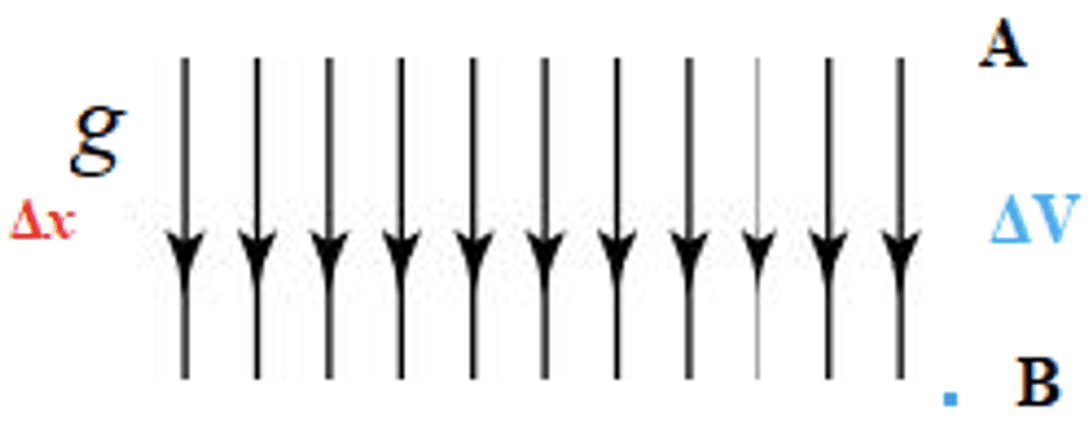
  • Consider the movement of a body in a gravitational field $(g)$:
    The work done in moving a mass $\rm (m)$ from $\rm A$ to $\rm B = m\Delta V_g{^{BA}} = -m\Delta V_g{^{AB}} = \mathrm F\Delta x$
    $\mathrm F\Delta x = \rm \Delta V_g{^{AB}}$
    $\rm F/m  = \rm\Delta V_g{^{AB}}/\Delta \cal x$ 
    $g =  -\rm \Delta V_g{^{AB}}/\Delta \cal x$
Potential gradient and Potential Difference

  • The potential gradient $=\Delta \mathrm V / \Delta x$.
  • In both gravitational and electrical fields, the field strength is the negative of the corresponding potential gradient.
  • The gradient of a graph of potential versus distance gives the (negative) field strength.
  • For a positive point charge $\rm Q$ the potential is $\mathrm V=k \mathrm Q / r$ and $d \mathrm V / d r=-k \mathrm Q / r^{2}$
    $\mathrm{E = F} / q = k\mathrm Q / r ^{2}$ so $\mathrm E=-\Delta \mathrm V / \Delta r$
  • Similarly for a mass $\rm M$ the potential is $\rm V=- GM / \cal r$ and so $g=-\Delta \mathrm V / \Delta r$
  • The work done when moving a mass or charge in a field by an external force depends only on the potential difference $\rm \Delta V$ and is independent of the path followed.

Escape velocity

  • The escape velocity is the minimum velocity a body at the surface of a planet must have to escape the planet's gravitational field and move to infinity. Assuming the planet is isolated with no atmosphere, as the body moves away from the planet, kinetic energy is converted to gravitational potential energy:
    loss in kinetic energy $=$ gain in (gravitational) potential energy.
    $\rm m$ is the mass of the body and M is the mass of the planet $\rm ½ m \mathcal v_{esc}{^2} = G M m / R$
    $v_{\rm escan}{^2} = \rm 2 G M / R$
    $v_{\rm esc} = \rm \sqrt{2 G M / R}$
  • The gravitational field strength at the surface of plant $(g)= \rm F / m=G M / R^{2}$
    $v_{\rm esc } = \rm \sqrt{2 g R}$

Energy changes during orbital motion

  • If the mass of the planet is $\rm M$ and the radius of the orbit of the satellite is $\rm R$, and the speed of the satellite, $v$, the centripetal force is provided by the gravitational force:
    $\mathrm m v^{2} / \rm R=G M m / R^{2}$
    $v^{2}=\rm G M / R$
  • The kinetic energy, of the satellite $\rm (E_K)=½ m \mathcal v^2 = ½ G M m / R$
    The gravitational potential energy, $(\rm E_{P})$ possessed by the satellite $(\rm E_P) =-G M m / R$
  • The total energy of a satellite.
    $\rm E_T= E_K + E_P = ½ G M m / R-G M m / R$ $\rm =-G M m / 2R$
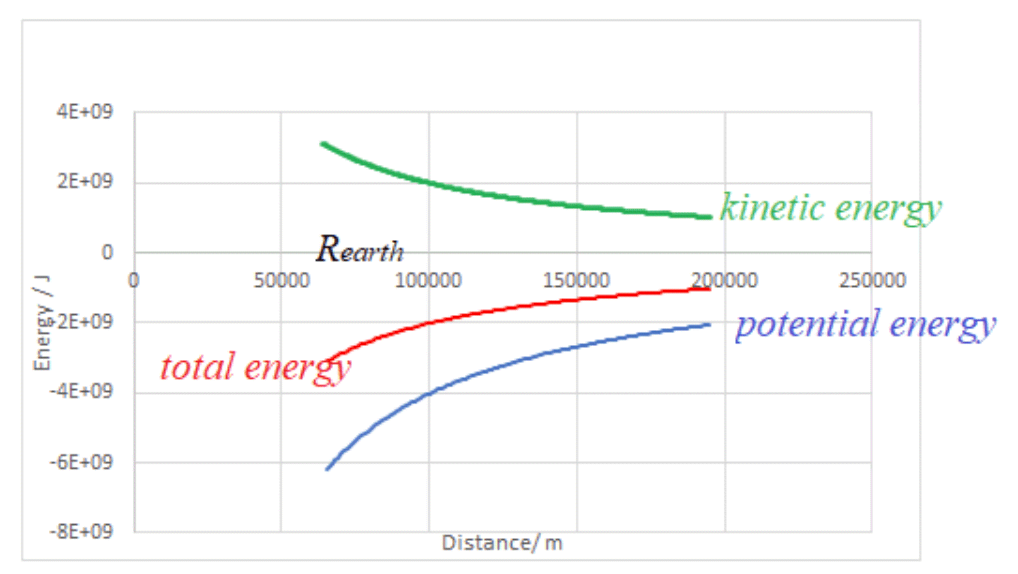
    A graph of the kinetic, potential and total energy of a $\rm 1~kg$ mass in circular orbit around the Earth.
  • Note the total energy $\rm(E_T)$ of a satellite) $=-$ kinetic energy $\rm(E_K)$ and is always negative.
    The total energy increases as the radius increases.
    The total energy decreases (becomes more negative) if a satellite falls to a lower orbit.

Possible Paths if object launched at different speeds

  • If an object is launched with an initial velocity:
    • $>$ escape velocity and the total energy is positive; it follows a hyperbolic path and never returns to the planet.
    • $=$ escape velocity and total energy is zero, the object follows a parabolic path to infinity and never returns to the planet.
    • $<$ escape velocity and the total energy is negative; the object will go into a circular or elliptical orbit (or crash into the planet if the launching speed is too low).

Worked Example

Deduce that the period of orbit $\rm T$ of a planet orbiting the sun is described by Kepler's 3rd law: $\rm T^2 / R^3 = \cal k$
Where $k$ is a constant, and find an expression for $k$.

Solution

Assuming the planet is in circular motion.
The centripetal force is provided by the gravitational force of attraction between the planet of mass $\rm m$ and the sun of mass $\rm M$ :
$\mathrm m v^{2} / \rm R=G M m / R^{2}$
$v^{2}=\rm G M / R$
The planet travels a distance $\rm 2 \pi R$ in time $\rm T$
$v=2 \pi \rm R / T$
$v^{2}=4 \pi^{2} \rm R^{2} / T^{2}= GM / R$
$\rm 4 \pi^{2} R^{3} / GM =T^{2}$
$\rm 4 \pi^{2} / G M=T^{2} / R^{3}$
$k=4 \pi^{2} / \rm GM$


FAQ