The limited resources of fossil fuel and their impact of their use on global warming has led to the development of alternative sources of energy.
- Primary energy is found in nature and has not been processed.
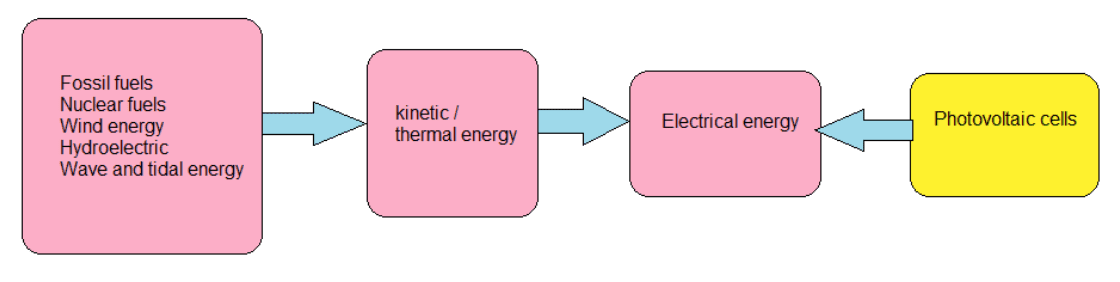
- Non-renewable sources of energy are finite sources, which are depleted at a rate faster than they can be produced. They include fossil fuels (e.g. oil, natural gas and coal) and nuclear fuels (e.g. uranium).
- Fossil fuels have been produced over millions of years when buried animal and plant matter has been decomposed by bacteria under high pressure. Their energy ultimately originates from the Sun’s radiated energy which was originally captured by plants during photosynthesis millions of years ago.
- Renewable sources of energy include solar energy, wind energy, wave energy, bio-fuels and tidal energy. Wind energy, wave energy, bio-fuels, sustainable sources (e.g. wood when used sustainably) are indirectly dependent on solar energy.
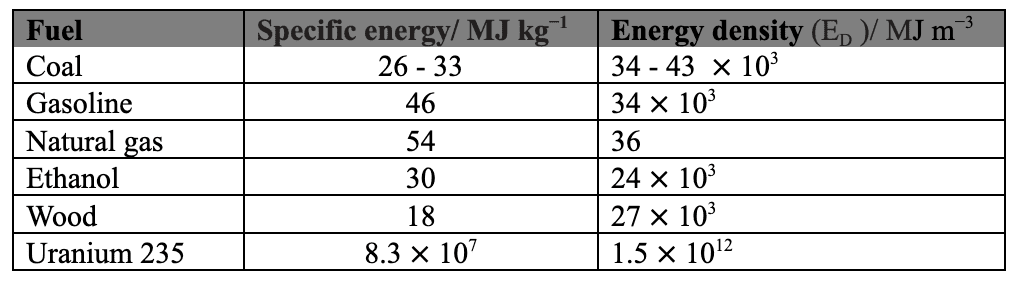
- The specific energy $\rm (E_S)$ of a fuel is the amount of energy that can be obtained from a unit mass of the fuel. It is measured in $\rm J kg^{-1}$.
- The energy density $\rm (E_D)$ of a fuel is the amount of energy that can be obtained from a unit volume of the fuel. It is measured in $\rm J m^{-3}$.