Electric cells

📝 Mini-cours GRATUIT

Emf and internal resistance

Electric cells allow us to store energy in a chemical form.

  • In a battery chemical energy is converted into electrical energy. The emf is the joules of electrical energy given to each unit of charge.
  • So far we have assumed that the internal resistance of the battery or power supply is negligible. We can now consider cells with an internal resistance $r$. This is due to the resistance of the components inside a battery.
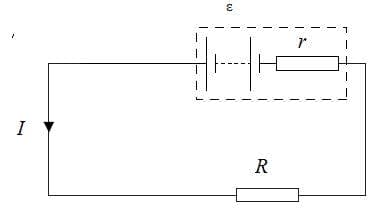
    The potential difference across the battery; the terminal potential difference:
    $\rm V = \varepsilon – Ir$
  • The potential difference across the battery is equal to the emf when the current in the circuit is zero.
  • The total electrical power by the battery $\rm = \varepsilon I$
  • Electrical power dissipated in a resistor $\rm = VI = I^2R = V^2/R$
  • When current is drawn from a cell, the terminal potential difference varies with time.
    The terminal potential difference of a typical cell:
    • Falls quickly from its initial value and then stays stable for most of its lifetime.
    • It then decreases rapidly to zero as the cell discharges.
  • The emf and internal resistance of a cell can be determined from the following circuit:
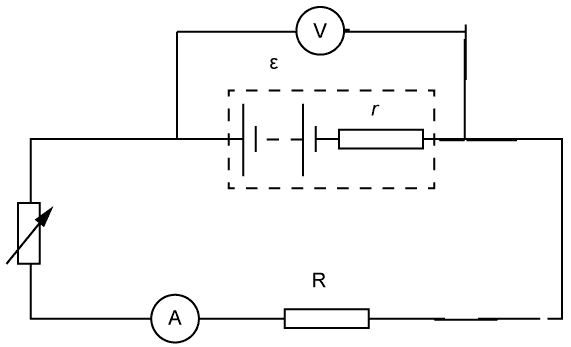
    The current is varied using the variable resistor and the terminal potential difference is measured.
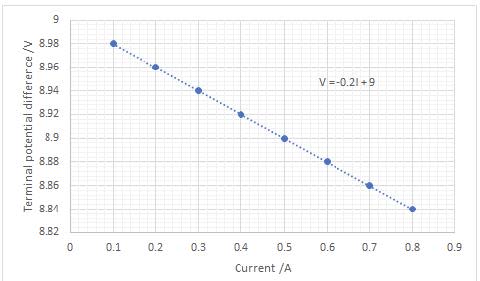
  • The emf is given by the vertical intercept: in this case $\rm \varepsilon = 9.0~ V$
  • The internal resistance is equal to the gradient; in this case $\rm r = 0.2~\Omega$.
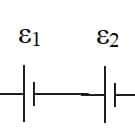
Combinations of Cells

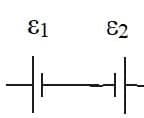
  • When cells are in series the voltage increases when they are connected in the same direction or decreases if they are connected in the opposite direction.
    $\rm \varepsilon_{total} = \varepsilon_1 + \varepsilon_2$
    The current flows to the left.
    $\rm\varepsilon_{total} = \varepsilon_1 - \varepsilon_2$
    The current flows to the left when $\rm \varepsilon_1 > \varepsilon_2$ and the right when $\varepsilon_1 < \varepsilon_2$
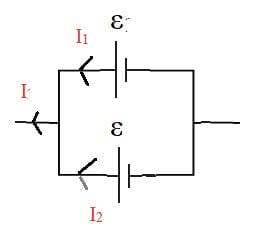
  • When cells are in parallel the current increases when they are connected in the same direction.
    When identical cells are in parallel
    εtotal = ε but I = I1 + I2
    When unlike cells are connected there are no simple relationships and Kirchhoff’s laws have to used.

Magnetic fields

Magnetism arises when one charge moves in the vicinity of another moving charge.

  • The poles of a magnetic are called north-seeking and south-seeking because they point in those directions if suspended. Magnets have dipoles: as north or south seeking poles cannot exist in isolation.
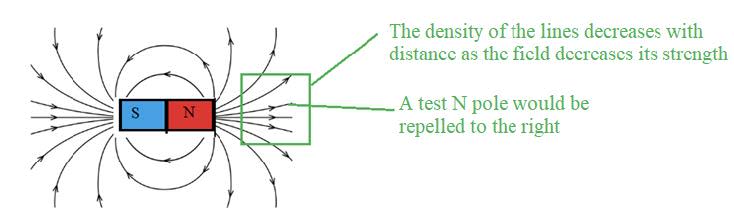
  • A magnetic field is a region of space where a ‘test’ magnet would experience a force. The field or flux lines show the direction of a force on the test’ magnetic north seeking pole if placed at that point.
  • The strength of the force at a point is shown by the density of lines at the point.
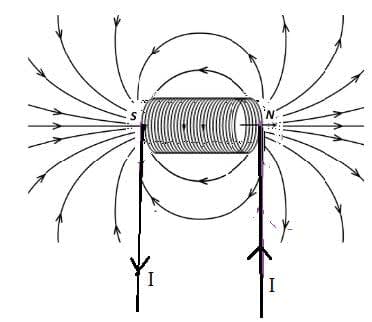
  • A similar magnetic field is produced when an electric current passed through a solenoid. The magnetic field pass through the inside of the solenoid from left to right.
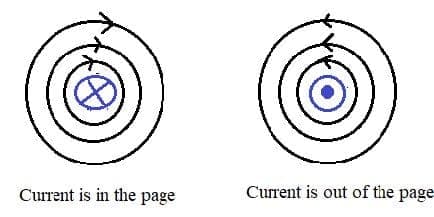
  • The current in a wire produces a magnetic field: a series of concentric circles. The direction of the field is reversed when the direction of the current is reversed.
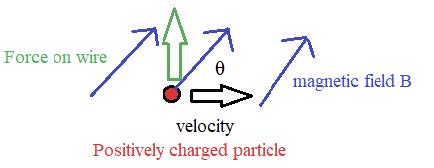
  • A magnetic field $\rm B$ exerts a force on moving charges given by $\mathrm F = qv\rm B \sin \theta$

    $\Theta$ is the angle between field and the velocity vectors.
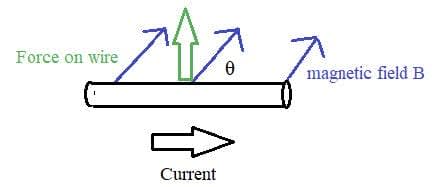
  • The force on electric currents given by $\rm F = BIL \sin \theta$.

    $\Theta$ is the angle between field and the current.
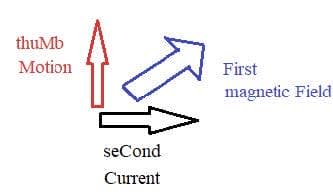
  • The directions can be predicted by the thumb, first finger and second finger of the left hand. The Left Hand Rule $\rm (LHR)$.

🎲 Quiz GRATUIT


FAQ