Describing field

📝 Mini-cours GRATUIT

Gravitational fields

Electric charges and masses influence the space around them. This can be represented with h the concept of electric and gravitational fields.

  • A body of mass $\rm M creates a gravitational field in the space around it. This fields acts on other bodies by exerting a gravitational force.
  • Gravitational field strength $(g) =$ force per unit test point mass $g =\mathrm F / m= \mathrm{GM}^{2}/r^{2}$
    $g$ has units: $\rm N~ kg ^{-1}$
    It is a vector quantity.
  • All masses are attracted towards the mass shown. Gravitational field lines end on masses.

Electrostatic fields

  • An electric charge $\rm Q$ creates an electric field in the space around it. This fields acts on other charges by exerting an electric force.
  • The electric field $\rm (E)$ at a point is the electric force per unit charge exerted on a small, positive point charge $q$ placed at that point. It is a vector quantity.
    For a charge $\rm Q$:
    $\mathrm{E =F} / q = k \mathrm Q q / q r^{2}$ $= k \mathrm Q/ r^{2}$
    capture-decran-2022-07-11-a-121544

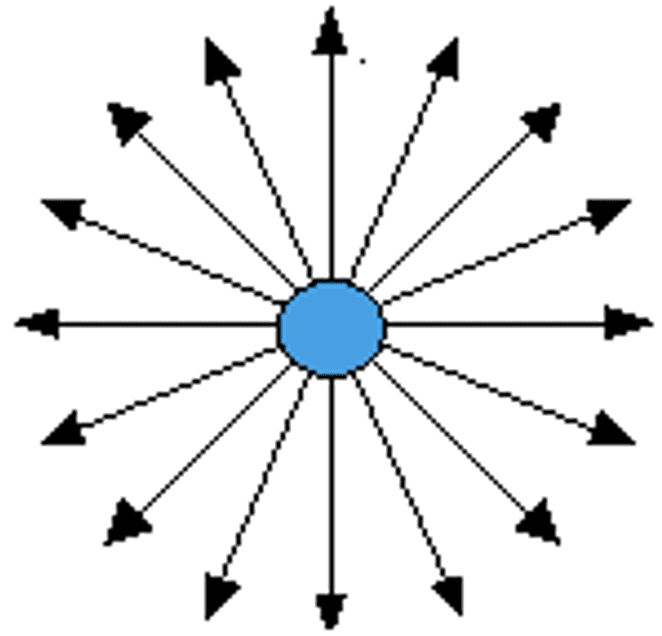
    The electric field of a positive charge.
    The lines are outward as a test positive charge is repelled. 

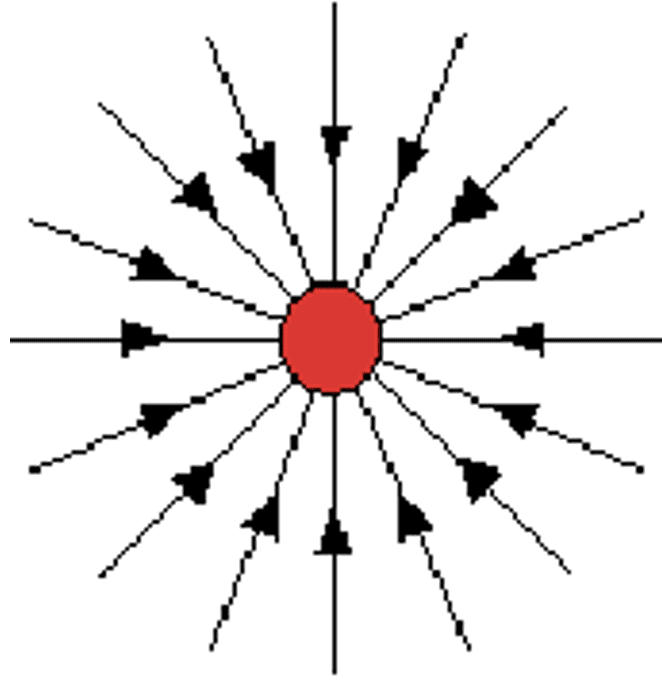
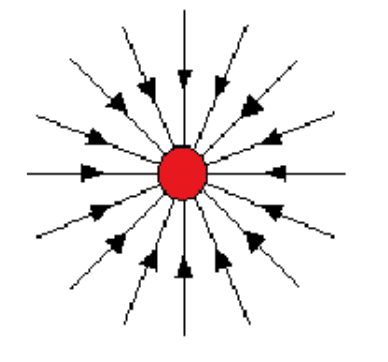
    The electric field of a negative charge. 
    The lines are inward as a test positive charge is attracted.
  • Electrostatic field lines start on positive charges and end on negative charges.

Field strength is a vector

  • Field strength is a vector. The direction of the field is shown directly and the magnitude of the field strength is represented by the closeness of the field lines.
  • Field lines:
    • never cross
    • are close together when the field is stronger.
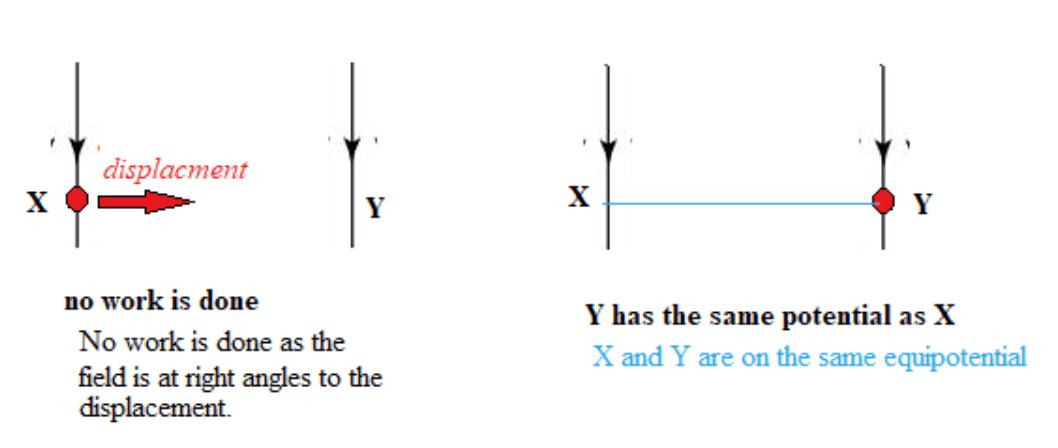
  • Work is done when an object is moved along a field line, but not if an object is moved at right angles to a field line. $\rm Work = F~s \cos\theta = 0$ when $\theta = 90°$.
  • As no work is done when an object moves at right angles to a field line there is no change in potential at right angles to a field line.

Gravitational and electric potential

Gravitational potential

  • The Gravitational potential $\bf(V_g)$ due to a mass $\rm M$ is the work done $\rm (W)$ by an external force per unit mass in moving a point mass $\rm (m)$ from infinity to a point near the mass $\rm M$.
    $\rm V_g = W/m$
  • The unit of gravitational potential is $\rm J~ kg^{-1}$.
  • The gravitational potential $(\mathrm V_g)$ at a distance, $r$, from a particle of mass, $\rm M$, $\mathrm V_g = -\mathrm{GM}/r$
  • As the mass $m$ is naturally attracted to $\rm M$ the work done is always negative.
  • The work done in moving a mass $\rm m$ from $\rm A$ to $\rm B = m(V_g{^B}– V_g{^A}) = m\Delta V_g{^{BA}}$

Electric potential

  • The Electric potential $\bf (V_e)$ due to a charge $\rm Q$ is the work done $\rm (W)$ by an external force per unit charge in moving a (positive) point charge $(q)$ from infinity to a point near the charge $\rm Q$.
    $\rm V_e = W/\cal q$
  • The unit of electric potential is the volt $\rm (V)$ which is equivalent to $\rm J ~C^{-1}$.
  • The electric potential $\rm (V_e)$ a distance $r$ from a body of charge $\rm Q$, $\mathrm{V_e} = \mathrm Q/r = \mathrm Q/4\pi \varepsilon r$.
    The sign of the potential depends on the sign of the charge.
  • When $\rm Q$ is positive there is repulsion between $\rm Q$ and the test charge $q$ and the work done is positive. When the $\rm Q$ is negative there is attraction between $\rm Q$ and the test charge $q$ and the work done is negative.
  • The work done in moving a charge $(q)$ from $\rm A$ to $\mathrm B = q\rm (V_e{^B} – V_e{^A})$ $= q \rm \Delta V_e{^{BA}}$

Gravitational and electric potential are both scalar quantities. To find the potential due to several masses or charges we simply need to add the potential due to each separate mass/charge.

Equipotential surfaces

  • Equipotential surfaces link points with the same potential. Equipotentials are at $90°$ to field lines.
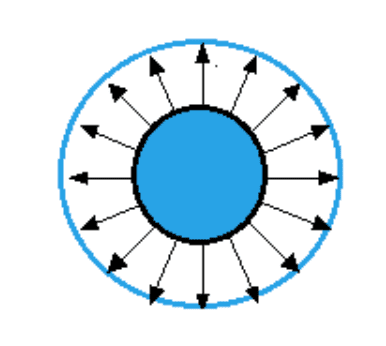
  • An equipotential surface in blue for a spherical mass or charge
  • Note there are no field lines in the body.
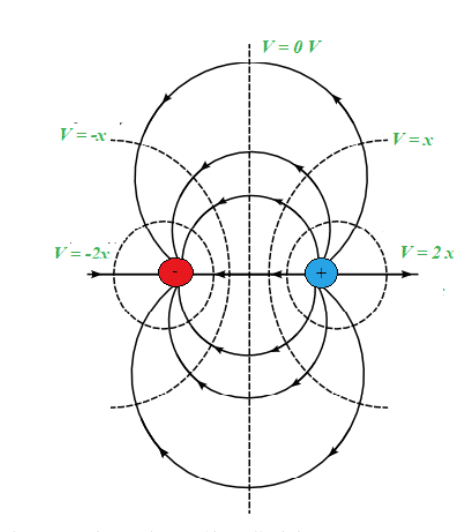
  • Equipotential surfaces for a positive charge and negative charges (dotted lines).
  • Note the field lines are at right angles to the equipotential surfaces.
  • Field lines and equipotential surfaces can both be used to describe fields. 
  • Equipotential lines cannot cross as one point cannot have two different potentials!
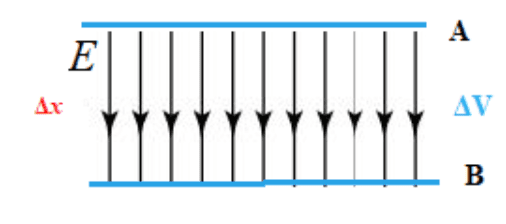
  • The work done in moving a charge $(q)$ from $\rm A$ to $\mathrm B = q \Delta \rm V _e{^{BA}}$ $=- q \Delta \rm V _e{^{ AB}}$ $= \mathrm F \Delta x$
    $\mathrm F \Delta x =- q \Delta \rm V_e{^{AB}}$
    $\mathrm F / q = -\Delta \mathrm{V_e{^{AB}}} / \Delta x$
    $\rm E =-\Delta V_e{^{AB}} / \Delta \mathcal x$
    $\rm E =-\Delta V_e / \Delta \cal x$

FAQ