
Oftentimes, it is useful to determine the number of different ways that many objects can be arranged. Whether it is the number of different ways an airline can go from city $\rm A$ to city $\rm B$ or the number of ways a salesman can sell from town to town and return home, it is useful to determine how many ways these activities can be done. If we can establish the total number of ways an activity can be accomplished, it will be helpful to later determine the most efficient way to accomplish this task. This leads us to the topic of combinations. The number of different arrangements of $n$ objects can be given as:
$n(n − 1)(n − 2)(n − 3) \ldots 2 \cdot 1 = n!$
Thus for example, $5! = 5 \cdot 4 \cdot 3 \cdot 2 \cdot 1 = 120$
The number of ways that $r$ objects can be chosen from $n$ objects is given by the formula:
$^n_r\mathrm C = \displaystyle\binom{n}{r} = \dfrac{n!}{r!(n-r)}$
The Binomial Theorem expands a polynomial of the form $(a + b)^n$.
$(a+b)^n = \displaystyle\binom{n}{0}a^nb^0 +\binom{n}{1}a^{n-1}b^1$ $+$ $\displaystyle\binom{n}{2}a^{n−2}b^2 +\ldots+\binom{n}{n}a^0b^n$
In the A&A SL course, it will be useful to understand that the $r^{\rm th}$ term of $(a + b)^n$ can be written as:
$\displaystyle\binom{n}{r−1}a^{n-(r-1)}b^{r-1}$
Example 1: $8$ books are arranged on a shelf. How many ways could $6$ books be chosen from $8$? Explanation: This is a combination problem where $n = 8$ and $r = 6$, or read as “$8$ choose $6$”.
$\rm ^8_6C = \dfrac{8!}{6!(8-6)} = \dfrac{8!}{6!\cdot 2!} = \dfrac{8 \cdot 7}{2\cdot 1} = 28$
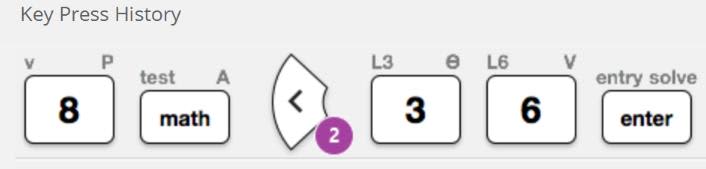
We can also use the TI-84 CE graphic display calculator by pressing the follow keys:
$\rm ^8_6C$
$\qquad \qquad \qquad28$
$\cdots\cdots\cdots\cdots\cdots\cdots$
Example 2: Use the binomial theorem to expand $(2x + y)^3$.
Explanation:
$(2x + y)^3 = \displaystyle\binom{3}{0}(2x)^3(y)^0 = 1(8x^3)^1$
$\qquad\qquad + \displaystyle\binom{3}{1}(2x)^2(y)^1 = 3(4x^2)y$
$\qquad\qquad + \displaystyle\binom{3}{2}(2x)^1(y)^2 = 3(2x)y^2$
$\qquad\qquad + \displaystyle\binom{3}{3}(2x)^0(y)^3 = 1(1)y^3$
$\qquad\qquad = 8x^3 + 12x^2y + 6xy^2 + y^3$
