
Causes of market failure
- Externalities
Positive, for example, school
Negative, for example, pollution
- Public goods
For example, army, street lighting, traffic lights, etc.
- Quasi-public goods
For example, infrastructures, motorway, roads
- Merit goods
Good under-consumed and under-produced to create positive externalities.
For example: opera, theater
- Asymmetric information
For example, if a landowner wants to sell his house, he would have more information about the house than the purchaser
- Imperfect competition
For example, banks
- Natural monopolies
For example, water, electricity
Reminder
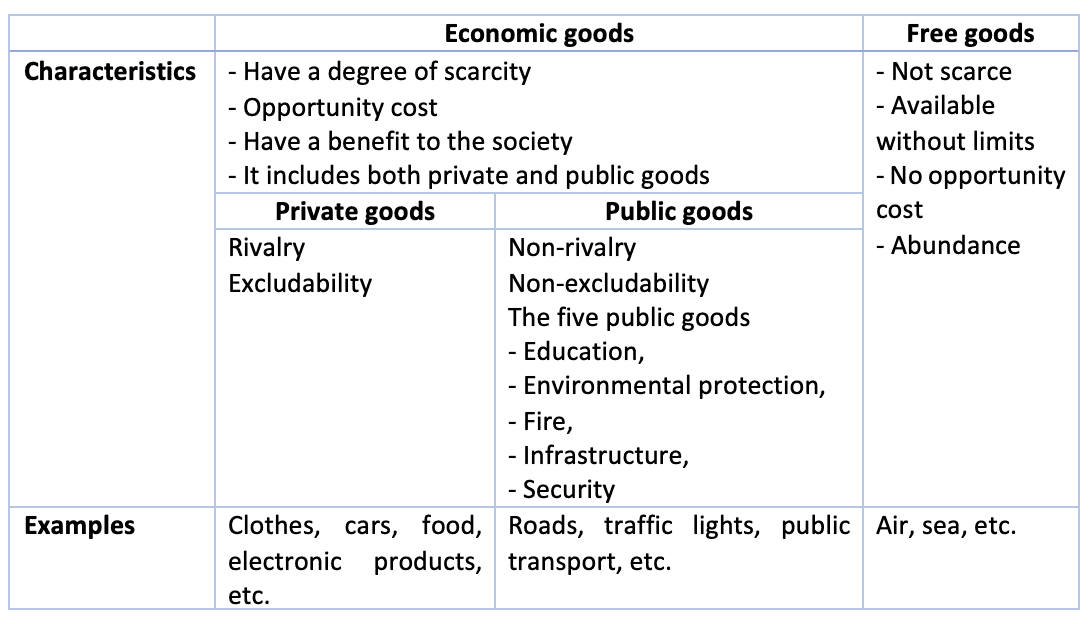
Externalities and common free goods
Externalities
There are both positive externalities (external benefits) and negative externalities (external costs).
For example, pollution (negative) and school (positive)
Common free goods
A free good is a good with zero opportunity cost. This means it can be consumed in as many quantities as needed without reducing its availability to others.
For example, air, sunlight, intellectual ideas, web-page, etc.
Public goods
Goods also named social good or collective goods. This type of goods is both non-excludable and non-rivalrous.
Asymmetric information
This type of market failure arises if the information available to the consumer or the producer in the market is unequal.
Market control
The Pareto-efficient output
Pareto efficiency or Pareto optimality is a situation in which no individual or preference criterion can be better off without making at least one individual or preference criterion worse or without any loss of it.
Two questions:
- How to identify the Pareto-efficient output
- Government’s role in ensuring the Pareto-efficient output
