
Market structures
Perfect competition model
- Perfect information
- Homogeneous goods
- Perfect mobility
- Price-takers
- Large number of firms
Monopolistic competition
- Perfect information
- Homogeneous goods
- Perfect mobility
- Price-takers
- Large number of firms
Oligopoly
- Perfect information
- Homogeneous goods
- Perfect mobility
- Price-takers
- Small number of firms
Monopoly
- Perfect information
- Homogeneous goods
- Perfect mobility
- Price-takers
- One firm
Conclusion

Market equilibrium
Equilibrium
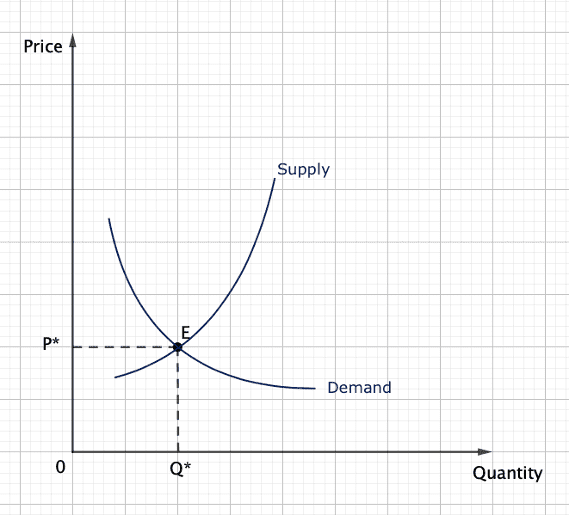
Equilibrium is attained at the price at which quantities demanded and supplied are equal. In other words, the equilibrium is the intersection point of demand and supply curves. Its coordinates are, most of the time, denoted (Q*, P*) where Q* is the equilibrium quantity and P* the equilibrium price.
Change in equilibrium
| Price | Quantity | |
| Demand increases | Increases | Increases |
| Demand decreases | Decreases | Decreases |
| Supply increases | Decreases | Increases |
| Supply decreases | Increases | Decreases |
| Supply increases | Supply decreases | |
| Demand increases | Price ? Quantity increases |
Price increases |
| Demand decreases | Price decreases Quantity ? |
Price ? Quantity decreases |
Key words
Shortage: when quantity supplied < quantity demanded
Surplus: when quantity supplied > quantity demanded
Disequilibrium: when quantity supplied ≠ quantity demanded (either a shortage or a surplus)
Equilibrium: when quantity supplied = quantity demanded
