
The Long-Run Phillips Curve (LRPC) and Short-Run Phillips Curve (SRPC)
The LRPC is vertical with, on the abscissa axis, the unemployment rate (in %) and, on the ordinate axis, inflation rate (in %).
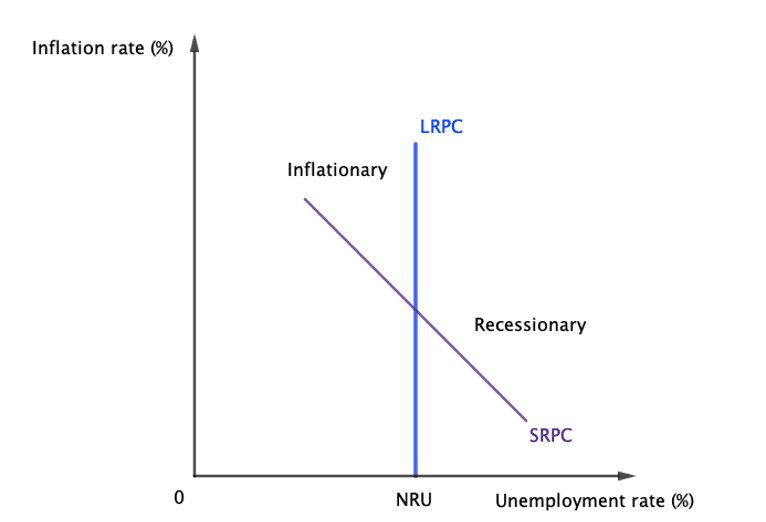
Phillips curve represents the inverse relationship between unemployment rate and inflation. This graph shows that wages tend to increase faster when unemployment rate is low.
The expected inflation rate is the intersection point of SRPC and LRPC.
NRU and NAIRU
NRU stands for Natural Rate of Unemployment.
The NRU has been replaced par the NAIRU which stands for Non-Accelerating Inflation Rate of Unemployment.
The NAIRU depends on the proper functioning of the labor market.
Main types of unemployment
Structural unemployment: long time, more than one year. It can take many years to people to acquire news skills.
Cyclical unemployment: it occurs with changes on economic activity.
Frictional unemployment: short term, about one month. It occurs when people change jobs.
Reducing NAIRU
Governments:
- Incite workers to take jobs
- Reduce bureaucratic requirements for businesses
- Encourage competition by controlling monopolies
- Prohibit anti-competitive practices between companies
- The aim of these policies is to decrease NAIRU and so to shift LRPC to the left.
Making the difference between supply side and demand side
The supply side concerns the organization of production to increase the output of the economy.
The demand side concerns the management of demand to influence the output of the economy.
