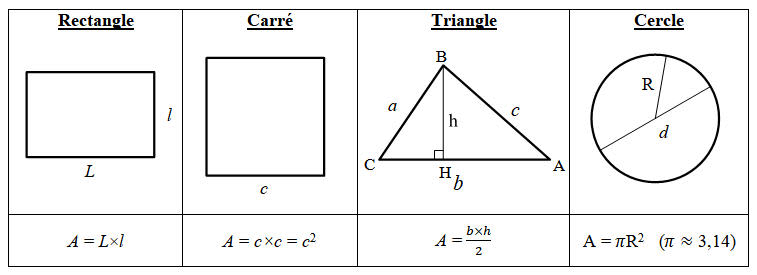

Formules de périmètres
Périmètres des figures usuelles



Dans le triangle $\mathrm{ABC}$ rectangle en $\mathrm{A}$, on a : ${\mathrm{BC}}^2 = {\mathrm{AB}}^2 + {\mathrm{AC}}^2$.
Le carré de l’hypoténuse est égal à la somme des carrés des deux autres côtés.
Dans un triangle $\mathrm{ABC}$ rectangle en $\mathrm{A}$, on a $\mathrm{AB = 3 \:cm}$ et $\mathrm {BC = 5\: cm}$.
Calculons $\mathrm{AC}$ :
D’après le théorème de Pythagore, on a ${\mathrm{BC}}^2 = {\mathrm{AB}}^2 + {\mathrm{AC}}^2$.
$5^2 = 3^2 + {\mathrm{AC}}^2$ donc ${\mathrm{AC}}^2 = 25 - 9 = 16$, puis $\mathrm{AC = \sqrt{16} = 4 \:cm}$.
Dans un triangle $\mathrm{ABC}$, si ${\mathrm{BC}}^2 = {\mathrm{AB}}^2 + {\mathrm{AC}}^2$, alors le triangle est rectangle en $\mathrm A$ et le segment $\mathrm{[BC]}$ est l’hypoténuse de ce triangle rectangle.
Soient $\rm A$, $\rm M$ et $\rm B$ trois points alignés et $\rm A$, $\rm N$ et $\rm C$ trois autres points alignés dans le même ordre.
On a deux configurations possibles :
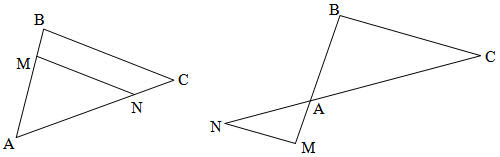
Si les droites $\rm (BC)$ et $\rm (MN)$ sont parallèles, alors on a $\displaystyle \frac{\rm{AM}}{\rm{AB}} = \frac{\rm{AN}}{\rm{AC}} = \frac{\rm{MN}}{\rm{BC}}$.
Savoir calculer le périmètre, l'aire ou le volume d'une figure ou d'un solide courant.
Ces formules sont utiles pour :
| Figure | Formule | Exemple |
|---|---|---|
| Carré | $\mathcal P = 4c$ | $c = 2 ~\rm{m} \rightarrow \mathcal P = 4 \times 2 = 8~ \rm{m}$ |
| Rectangle | $\mathcal P = 2 \times (L + \ell)$ | $L = 3 ~\rm{m}$, $\ell = 2 ~\rm{m} \rightarrow \mathcal P = 2 \times (3 + 2) = 10 ~\rm{m}$ |
| Cercle | $2\pi R$ | $R = 4 ~\rm{m} \rightarrow \mathcal P = 2\pi \times 4 = 8\pi ~\rm{m}$ |
⚠️ Le périmètre d'un cercle est aussi sa circonférence.
| Figure | Formule | Exemple |
|---|---|---|
| Carré | $\mathcal A = c^2$ | $c = 2 ~\rm{m} \rightarrow \mathcal A = 2^2 = 4~ \rm{m}^2$ |
| Rectangle | $\mathcal A = L \times \ell$ | $L = 5~ \rm{m}$, $\ell = 4 \rm{m} \rightarrow \mathcal A = 5 \times 4 = 20~ \rm{m}^2$ |
| Triangle | $\mathcal A = \dfrac{b \times h}{2}$ | $b = 5 ~\rm{m}$, $h = 4 ~\rm{m} \rightarrow \mathcal A = \dfrac{4 \times 5}{2} = 10~ \rm{m}^2$ |
| Parallélogramme | $\mathcal A = b \times h$ | $b = 2 ~\rm{m}$, $h = 4 ~\rm{m} \rightarrow \mathcal A = 2 \times 4 = 8~ \rm{m}^2$ |
| Trapèze | $\mathcal A = \dfrac{(B + b) \times h}{2}$ | $B = 3~ \rm{m}$, $b = 2 \rm{m}$, $h = 4~ \rm{m} \rightarrow \mathcal A = \dfrac{(3 + 2) \times 4}{2} = 10 ~\rm{m}^2$ |
| Cercle | $\pi R^2$ | $R = 3 ~\rm{m} \rightarrow \mathcal A = \pi \times 3^2 = 9\pi ~\rm{m}^2$ |
| Solide | Formule | Exemple |
|---|---|---|
| Cube | $\mathcal V = c^3$ | $c = 2 ~\rm{m} \rightarrow \mathcal V = 2^3 = 8 ~\rm{m}^3$ |
| Pavé droit | $\mathcal V = L \times \ell \times h$ | $L = 5 ~\rm{m}$, $l = 4 \rm{m}$, $h = 3 ~\rm{m} \rightarrow \mathcal V = 5 \times 4 \times 3 = 60 ~\rm{m}^3$ |
| Cylindre | $\mathcal V = \pi R^2 h$ | $R = 5 ~\rm{m}$, $h = 4 ~\rm{m} \rightarrow \mathcal V = \pi \times 5^2 \times 4 = 100\pi ~\rm{m}^3$ |
| Pyramide | $\mathcal V = \dfrac{\mathcal A \times h}{3}$ $\mathcal A$ : aire de base |
$\mathcal A = 12 ~\rm{m}^2$, $h = 4 ~\rm{m} \rightarrow \mathcal V = \dfrac{12 \times 4}{3} = 16 ~\rm{m}^3$ |
| Cône | $\mathcal V = \dfrac{\pi R^2 h}{3}$ | $R = 6 \rm{m}$, $h = 4 ~\rm{m} \rightarrow \mathcal V = \dfrac{\pi \times 6^2 \times 4}{3} = 48\pi ~\rm{m}^3$ |
| Sphère | $\mathcal V = \dfrac{4}{3}\pi R^3$ | $R = 3 ~\rm{m} \rightarrow \mathcal V = \dfrac{4}{3}\pi \times 3^3 = 36\pi ~\rm{m}^3$ |
Savoir reconnaître quand utiliser Pythagore et calculer la longueur d'un côté dans un triangle rectangle.
Le théorème de Pythagore sert à :
⚠️ Le théorème de Pythagore ne s'applique que dans les triangles rectangles !
Exemple
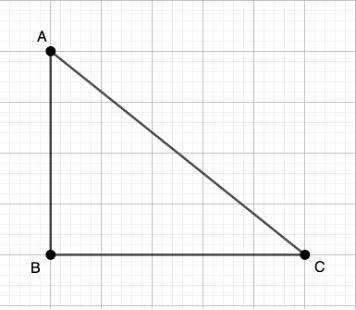
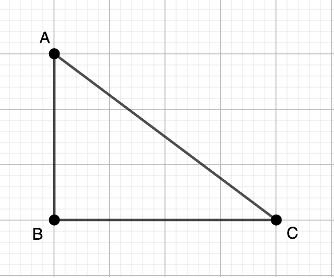
Dans ce triangle $\rm{AC}$ est l'hypoténuse et $\rm{AB}$ et $\rm{BC}$ sont les côtés de l'angle droit.
Dans un triangle le carré de la longueur de l'hypoténuse est égal à la somme des carrés des longueurs des deux autres côtés.
Dans le triangle $\rm{ABC}$ rectangle en $\rm{B}$ ci-dessus :
$$\rm{AC}^2 = \rm{AB}^2 + \rm{BC}^2$$
Exemple
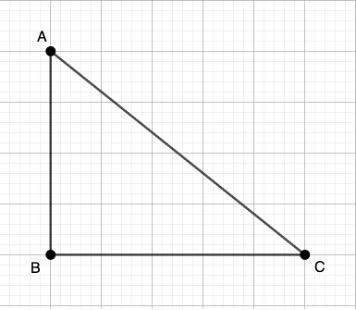
Dans ce triangle $\rm{ABC}$, $\rm{AB} = 4$ et $\rm{BC} = 5$.
Ainsi l'hypoténuse $\rm{AC}$ est donnée par :
$\rm{AC}^2 = \rm{AB}^2 + \rm{BC}^2$
$\rm{AC}^2 = 4^2 + 5^2$
$\rm{AC}^2 = 16 + 25$
$\rm{AC}^2 = 41$
$\rm{AC} = \sqrt{41} \approx 6,4$ unités de longueur
Si dans un triangle, le carré de la longueur du plus grand côté est égal à la somme des carrés des longueurs des deux autres, alors le triangle est rectangle.
Exemples
Comprendre et appliquer le théorème de Thalès pour calculer des longueurs dans des triangles avec des droites parallèles.
Le théorème de Thalès est un outil clé pour :
⚠️ Le théorème de Thalès ne s'applique que dans le cas de droites parallèles !
Exemple
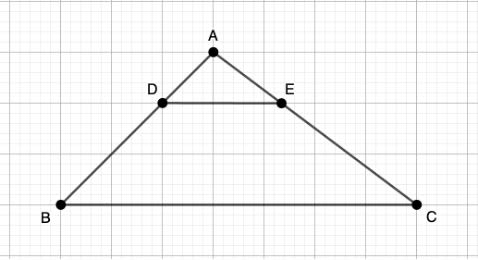
Les triangles $\mathrm{ADE}$ et $\mathrm{ABC}$ sont semblables.
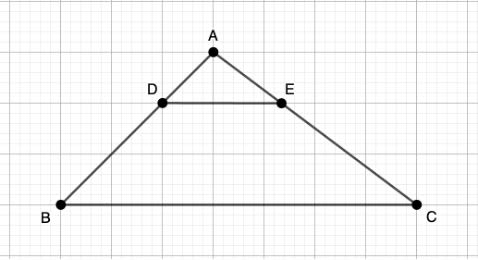
Dans le triangle $\mathrm{ABC}$ ci-dessus, $\mathrm{D}$ appartient à $[\mathrm{AB}]$, $\mathrm{E}$ appartient à $[\mathrm{AC}]$ et les droites $(\mathrm{DE})$ et $(\mathrm{BC})$ sont parallèles. On a alors l'égalité des rapports suivants :
$$\frac{\mathrm{AD}}{\mathrm{AB}} = \frac{\mathrm{AE}}{\mathrm{AC}} = \frac{\mathrm{DE}}{\mathrm{BC}}$$
Exemple
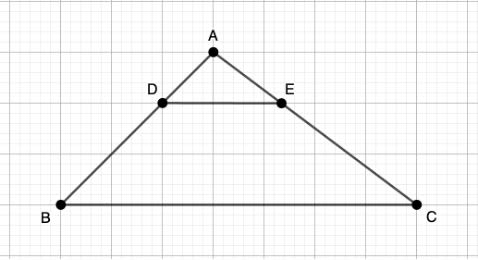
Dans ce triangle $\mathrm{ABC}$, on a : $\mathrm{AB} = 4,24 ~\rm{cm}$, $\mathrm{AC} = 5 ~\rm{cm}$ et $\mathrm{BC} = 7~ \rm{cm}$
On a aussi $\mathrm{AD} = 1,41$ et $\mathrm{AE} = 1,67$
Quelle est la longueur du segment $\mathrm{DE}$ ?
Les droites $(\mathrm{DE})$ et $(\mathrm{BC})$ sont parallèles donc :
$$\frac{\mathrm{AD}}{\mathrm{AB}} = \frac{\mathrm{AE}}{\mathrm{AC}} = \frac{\mathrm{DE}}{\mathrm{BC}}$$
En appliquant le théorème de Thalès :
$$\frac{1,41}{4,24} = \frac{1,67}{5} = \frac{\mathrm{DE}}{7}$$
En considérant les deux derniers rapports :
$$\frac{1,67}{5} = \frac{\mathrm{DE}}{7}$$
On obtient par une règle de trois :
$$\mathrm{DE} = \frac{1,67 \times 7}{5} \approx 2,3$$
Ainsi $\mathrm{DE} \approx 2,3 ~\rm{cm}$
Si, dans un triangle, on place une droite qui coupe deux côtés, et que les rapports des longueurs sont égaux, alors la droite est parallèle au 3ᵉ côté.
Exemples
Dans la figure ci-dessous, on a :
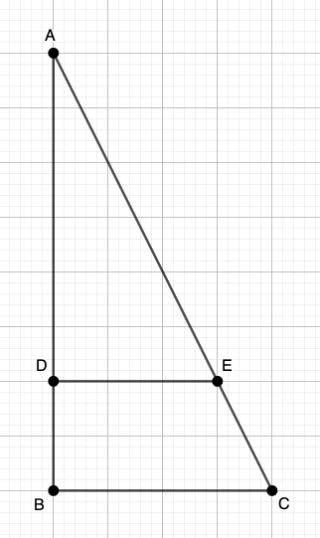
$\mathrm{AD} = 6~ \rm{cm}$
$\mathrm{AB} = 8 ~\rm{cm}$
$\mathrm{BC} = 4 ~\rm{cm}$
On a :
$$\frac{\mathrm{AD}}{\mathrm{AB}} = \frac{6}{8} = \frac{3}{4}$$
Et :
$$\frac{\mathrm{DE}}{\mathrm{BC}} = \frac{3}{4}$$
Les deux rapports étant égaux, les droites $(\mathrm{DE})$ et $(\mathrm{BC})$ sont parallèles.
 Géométrie 1Géométrie 2Géométrie 3Géométrie 4Géométrie 5Géométrie 6Géométrie 7Géométrie 8
 Mémorise les formules de volumesMémorise les formules d'airesMémorise les formules de périmètresMémorise les propriétés des trianglesMémorise les propriétés des quadrilatèresMémorise les théorèmesMémorise les conversions
 Notion/PropriétéUnité/ÉquivalenceFormule/Notion